This article was created by Peter Hoenig with the support of the AI Claude; the essential lines of thought come from Peter Hoenig, who published the article.
“We need to become faster and bolder,” says the management. “First we need clear rules,” says quality assurance. “And who is asking the people?” say the works council and HR. “The solutions must be integrable, have clear organisational and technical interfaces and fit our company,” say enterprise architecture management and the head of IT (CIO). “The processes must remain workable and take people with them,” notes process management. “And the whole thing should stay affordable or ideally cost nothing,” says the CFO.
All of them are right – seen from their own perspective – and all of them are speaking from a different value system. What is needed is an integrated, holistic view of the situation that takes all the parts into account.
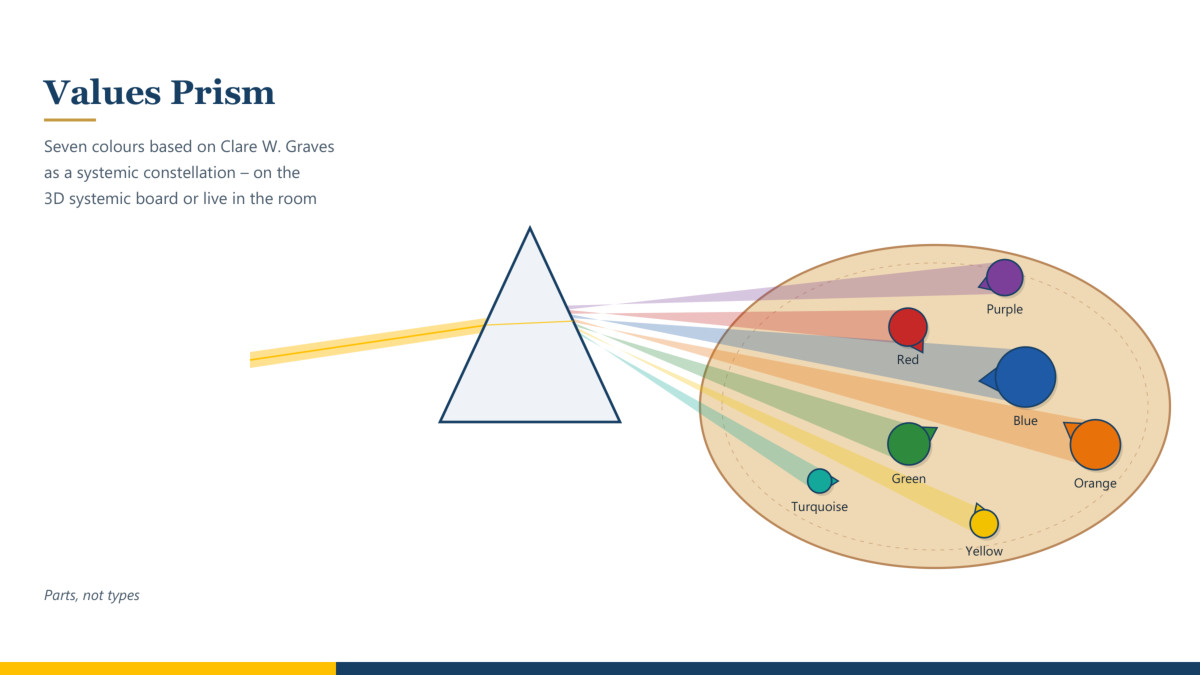
I know tensions like these from many years of IT projects and enterprise architecture management. They can be debated for a long time – and they often are, until they are sometimes simply talked to death. The picture and the situation often become clearer when they are set up: each value colour is given a figure or a person, a place, a size and a direction of gaze. I call this format the Values Prism. The idea for it came about in Stephan Landsiedel’s masterclass (www.landsiedel-seminare.de), together with two other participants and me; I added Theory U and developed it further. The Values Prism combines the values model of Clare W. Graves with systemic constellation work – on the 3D systemic board or live with a group in the room.
At a glance
- The Values Prism is a constellation format: seven colours of the values model based on Clare W. Graves – purple, red, blue, orange, green, yellow and turquoise – are set up as figures or people.
- What is set up is an organisation with its colour shares, your own person with its shares – or both together.
- Size, distance and direction of gaze show how strongly a colour is at work and how the parts relate to one another.
- Several pictures of the future are used to explore how the colours might work together in future – with guiding questions along Theory U, the logical levels according to Dilts and an ecology check.
- Two variants: on the free 3D systemic board, also on a tablet, or live as a group constellation with more than seven participants.
- I use the values model, Theory U and the Dilts pyramid as models for reflection and dialogue, not as diagnostic instruments.
Why “Values Prism”?
A prism makes visible what is hidden in white light: it fans the light out into its colours. This format works in the same way. An organisation or a person first appears as a whole – as “our culture” or as “that’s just how I am”. In the constellation, the individual colours appear, together with their weight and their relationships to one another. And as with a prism, the path can be reversed: at the end, the colours flow back together – into a picture in which every part has its proper place.
Spiral Dynamics and Graves: the seven colours as parts
From the 1950s onwards, the American psychologist Clare W. Graves studied how people’s values develop. He concluded that value systems emerge in response to the prevailing conditions of life. Don Beck and Christopher Cowan developed his model further and made it widely known in 1996 under the name Spiral Dynamics®; they assign colours to the value systems and speak of vMemes, or value memes. I describe both models in more detail on the page Spiral Dynamics and the Graves Value Model.
- Purple – belonging and a sense of safety: cohesion, loyalty, rituals.
- Red – strength and drive: energy, courage, assertiveness and pace.
- Blue – order and duty: rules, reliability, fairness and structure.
- Orange – achievement and progress: goals, competition, innovation and efficiency.
- Green – community and humanity: participation, appreciation and balance.
- Yellow – systemic, flexible thinking: recognising connections, competence rather than rank.
- Turquoise – wholeness and connectedness: meaning, sustainability, responsibility beyond one’s own boundaries.
Almost every person and every organisation carries several of these colours. That is why, in the Values Prism, I do not set up “types” but parts: not “we are blue”, but “blue is big here – and is currently looking mainly at red”. No colour is better than any other; each has its strengths and can be taken to excess. I do not set up the basic drive for survival, which Beck and Cowan call beige – just as in my values profile, which is why the two fit together well.
Who is the Values Prism for?
Anyone who designs systems also shapes values – whether consciously or not. That is why the Values Prism is a good reflective exercise for everyone who accompanies organisations, processes or people through change:
- Enterprise architects: every target architecture presupposes values: self-service and decentralised decisions call for something different from a landscape in which every change has to pass through several committees. Anyone who shapes architecture therefore needs to communicate well with people of every colour – in their own language. Beck and Cowan call someone who can do this a “spiral wizard”. It works best from yellow or – so far reached by only a few – from turquoise or coral: with a systemic, flexible view that understands the logic of every other colour instead of judging it. (In the model, coral stands for a possible level after turquoise; I do not set it up in the Values Prism.) In the 8-Level Model I ask whether tools, processes and organisation fit the vision and mission – the Values Prism shows which colours support this path and which hold it back.
- Process managers: processes are blue in action. The first priority is to understand the blue parts and to speak with them. But designing processes is design work: it needs creative, systemic thinking from yellow and involves the blue, green and orange parts of the people concerned – otherwise you get paper processes that nobody follows instead of processes that are actually lived. On the board you can try out what a new rule does to red, orange and green before it appears in the process manual.
- Management consultants: anyone who advises brings their own colours along – and easily sees in the client what their own colour lacks. That is why you should be aware of your own colours and values and be able to advise from yellow. The Values Prism helps to test assumptions about a culture and to recognise your own lens.
- Managing directors and CEOs: behind every strategy lies a picture of which values will become more important. Which colour needs to grow, which may become smaller without anything valuable being lost – and what does that mean for you yourself? How do you develop your company so that it serves a larger whole without losing the customer base and with it the basis of your livelihood? How do you need to develop yourself in order to stay successful in the market or even gain market share? Which value systems are to the fore in the cultures and regions you want to expand into – so that entering a new market does not end in shipwreck? And in an acquisition or a joint venture: which colours shape your company, which the partner company – and can the different colour constellation even be turned into synergies?
- Coaches: the format combines four widely used approaches – the values model, constellation work, logical levels and Theory U – into a clear sequence with guiding questions. Coaches should be aware of their own colours and values and be able to accompany from yellow.
- Coachees: they experience their own parts instead of only talking about them, and leave the session with a concrete next step.
Variant 1: the Values Prism on the 3D systemic board
For working on your own, in one-to-one coaching or by video, you can use my free 3D systemic board. It runs in the browser, needs no installation and transmits no data. It can also be used on a tablet: the bars open as windows, you tap a figure and then tap the board – and it is in place.
- Choose your perspective: set up your organisation – the whole company or one area of it –, yourself, or yourself as a figure of your own in the midst of your organisation’s colours.
- Create the seven colours: place one figure for each colour and give it the colour and a name, such as “Blue – order”. Colours that are missing from the selection, such as turquoise, can be set via the custom colour. Under “Meaning of the colours” you record what each colour stands for.
- Set up the current picture: size shows how strongly a colour is at work today, distance how close two colours are, and direction of gaze what a colour is paying attention to. Whatever has little effect today stands small, on the edge or beside the board. Symbols such as goal, resource or obstacle complete the picture.
- Look at it: from above, from all sides and from the point of view of each colour. Whom does blue see? Who is looking at blue? To whom does blue turn its back?
- Make changes and observe the effect: make a figure bigger or smaller, turn or move it – what changes for the other colours? What does red gain when blue turns around?
- Set up pictures of the future: “+ Picture” copies the current picture, and in the copy you set up a scenario, such as “growth”, “succession” or “crisis”. Two pictures can be compared side by side. You go through each picture with the guiding questions in the next section.
- Record the result: the picture sheet shows the pictures from above, from the front and from the point of view of the figures, and can be saved as a PDF.
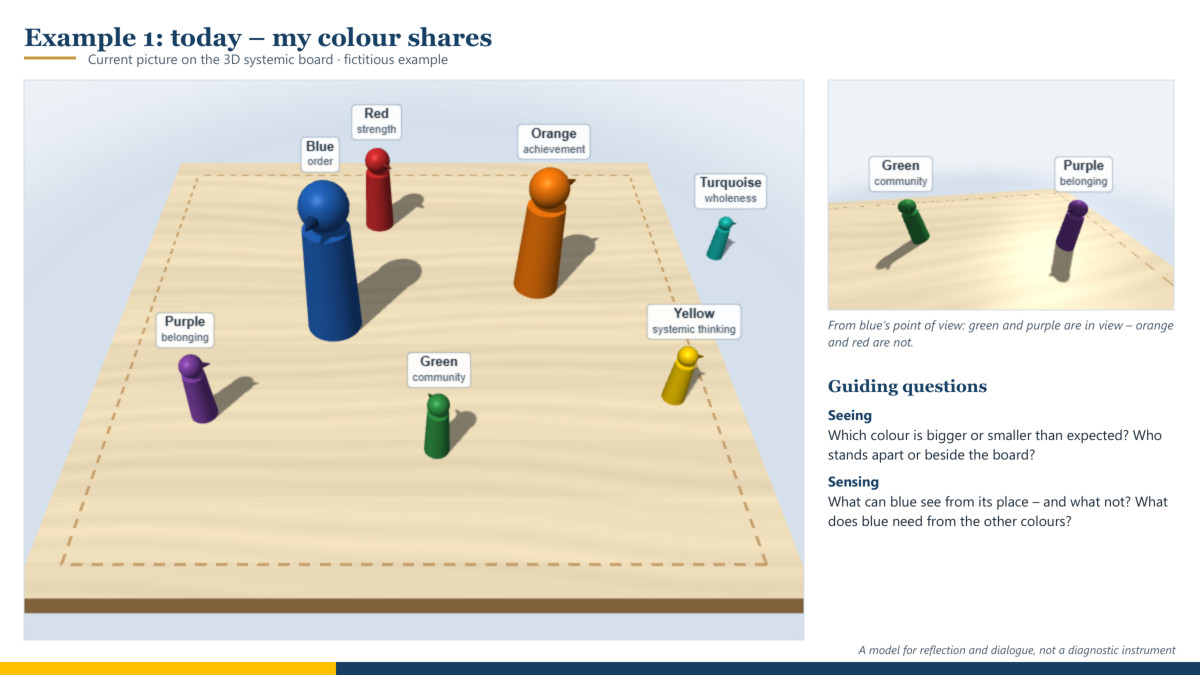
Example 1 (fictitious): this is what the current picture of your own colour shares might look like. Blue and orange are large and look away from each other, green stands small at the front, turquoise beside the board. From blue’s point of view, green and purple are in view – orange and red are not. Guiding questions: Which colour is bigger or smaller than expected? What can blue see from its place – and what not?
My free values profile questionnaires give a good first estimate for the constellation – for organisations and for individuals. The shares in the result can be used as the sizes of the figures; it is not necessary, though – the Values Prism lives from your inner picture. You can read more about the tool on the page 3D systemic board and in the post The systemic board.
Guiding questions for each picture of the future – along the U
So that a picture of the future does not stop at wishful thinking, the coach can take each picture once through the U of Theory U by C. Otto Scharmer: first downwards – looking closely, empathising, pausing – and then back up to resources, first steps and everyday practice. I show the questions using blue as an example; they apply to every colour.
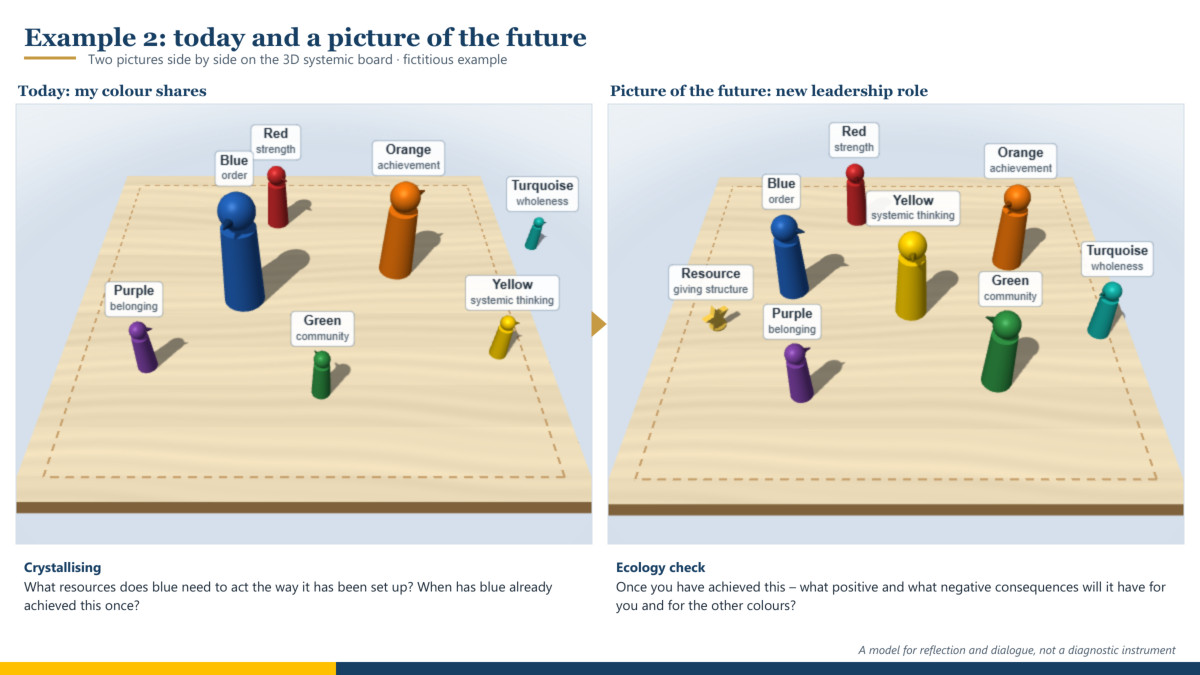
Example 2 (fictitious): the current picture and the picture of the future “new leadership role” compared. Yellow stands in the centre, green has grown, blue has become smaller, looks towards the centre and has a resource beside it, and turquoise is on the board. Guiding questions: What resources does blue need to act the way it has been set up? When has blue already achieved this once? And the ecology check: what positive and what negative consequences will it have for you and for the other colours?
1. Downloading: the familiar picture
- How do we usually describe our culture – and which colour would “people here” name first?
- Which explanation is on the tip of my tongue as soon as I see this picture?
2. Seeing: suspending judgement
- What does the picture show that I did not expect? Which colour is bigger or smaller than I thought?
- Who is standing close together, who is apart, who is looking where – if I only describe and do not judge?
3. Sensing: switching to the point of view of a colour
- What is it like to stand in this place as blue? What can blue see from here – and what not?
- What does blue need from the other colours? What does it fear if red or green grow bigger?
4. Presencing: pausing
- If every colour had its proper place: what would it really be about?
- What may I – what may we – let go of so that this picture of the future becomes possible?
5. Crystallising: the picture of the future and its resources
- What resources does blue need in order to be able to act in future the way it has been set up here?
- When has blue already achieved this once? What resources did it have then – and which of them are still there today?
- How does this show itself on the levels of the Dilts pyramid? Environment: where, when and with whom is blue at work? Behaviour: what exactly does blue do then? Capabilities: what is blue able to do then? Values and beliefs: what matters to blue, what does it believe? Identity: who is blue then? Belonging and purpose: what for, and for whom, is blue at work?
6. Prototyping: small steps and an ecology check
- What is the smallest step with which blue can try out its new role – and how will the other colours be the first to notice?
- Ecology check: once you have achieved this – what positive and what negative consequences will it have for you? For the other colours, for your team, for your environment? What needs to be protected so that nothing valuable is lost?
7. Bringing into the world: the way into everyday practice
- What do we take away from this picture – into processes, roles, decisions and tools?
- Who needs to know about it? How will we recognise in a few weeks that something has changed?
Along the way, the three inner voices described by Scharmer often make themselves heard: judgement, cynicism and fear. A helpful question then is: from which colour is this voice speaking right now? At the end, it is worth comparing the pictures of the future: which one feels right – and what do all the pictures that feel right have in common?
Variant 2: the Values Prism as a group constellation live in the room
The Values Prism is at its most powerful when the colours come to life: as a group constellation with more than seven participants. Seven people stand for the seven colours; in addition there is you, as the person setting up your issue, and me as the coach. The work takes place in a large room or outdoors in a meadow.
What you need: room to walk around, several sturdy stepladders, cards or cloths in the seven colours so that each role is recognisable, and enough time for the constellation and the follow-up conversation. Size in the room: a colour becomes bigger when its representative climbs a stepladder, and smaller when they crouch down.
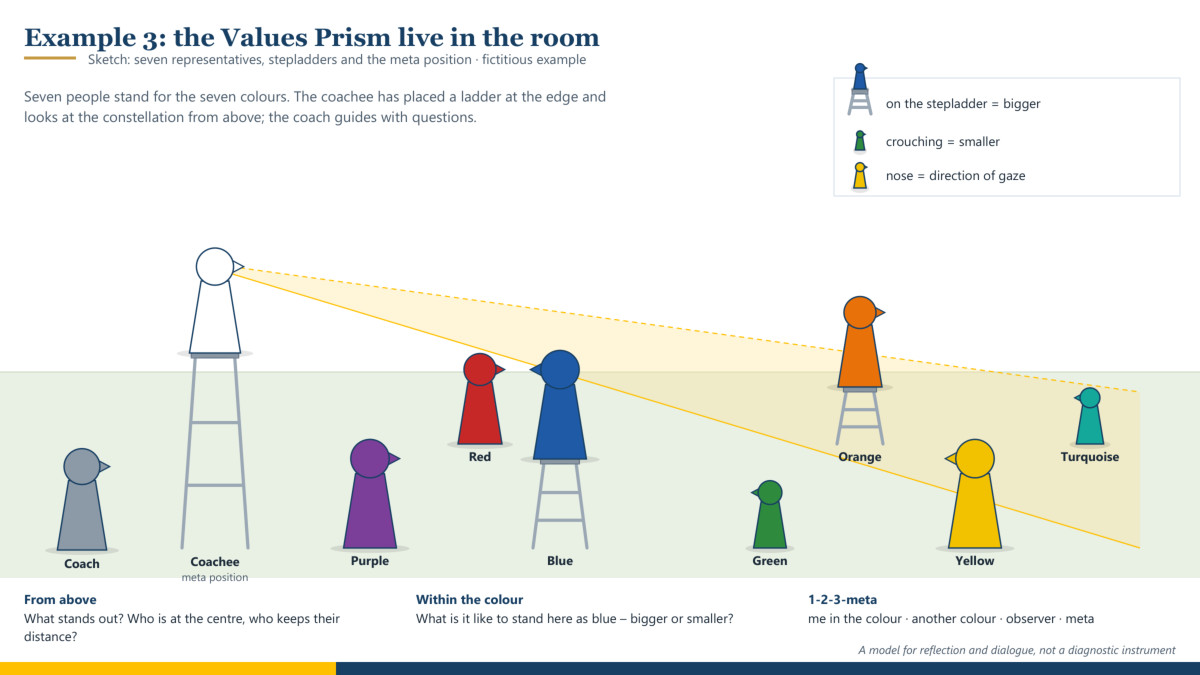
Example 3 (fictitious): sketch of a constellation in the room. Blue and orange stand on stepladders, green and turquoise crouch down. The coachee has placed a ladder at the edge and looks down at the picture from above. Guiding questions: What stands out from above – who is at the centre, who keeps their distance? What is it like to stand here as blue yourself, bigger or smaller?
- Setting the frame: we clarify your issue and agree on voluntary participation, confidentiality and a stop signal. Anyone who takes on a role speaks from the role – not about themselves.
- Choosing representatives: you choose seven people, one for each colour, and give each of them their colour card.
- Setting up: you lead each person to their place, align their direction of gaze and decide their size – on the ladder, standing or crouching.
- First round: I ask the representatives what they perceive in their place: Whom can you see, whom not? Where are you drawn to? The answers are offers, not truths – you decide what fits.
- Walking through and looking from above: you walk through the constellation and set up a ladder at any point you like in order to look at the picture from above. From there, patterns appear that cannot be seen from below.
- Setting up pictures of the future: you change places, sizes and directions of gaze and set up different scenarios one after the other. The representatives say what changes for them; the guiding questions along the U accompany each picture.
- Stepping into a colour yourself: you take over the place of a colour; its representative leaves the field for this. You empathise with the colour, make yourself bigger or smaller in it and sense what changes as a result – within you and in the way you see the others.
- Opening up resources: under my guidance, you look from within the colour into the past (“When have I already lived this colour powerfully?”) and into the future (“How does it feel when it works the way it does in the picture of the future?”). Alternatively, we go through the perceptual positions 1-2-3-meta: your own view within the colour, the view of another colour, the view of an observer – ideally from the ladder – and a meta position that looks at the whole process. You can read more about this in the post Floor anchors.
- Integrating: you take what you have found back to your place – as an image, a sentence or a gesture. One last look at the solution picture, then comes the ecology check.
- Releasing the roles and closing: all representatives are consciously released from their roles, put down their colour card and say their own name again. The follow-up conversation leaves room for what everyone has experienced. If you like, you can recreate the solution picture on the 3D systemic board afterwards.
Setting a careful frame for constellation work in coaching
A Values Prism in the room is a very intense experience – for the person setting it up, and often for the representatives too. That is why it belongs in a clear frame:
- It is led by a coach with experience in constellation work; there is enough time for the preliminary and follow-up conversations.
- Everyone takes part voluntarily, everything remains confidential, and stopping is possible at any time.
- Perceptions within a role are offers, not truths. Nobody is judged – not even the people one might associate with a colour.
- Stepladders stand on firm, level ground; anyone who climbs up is secured. At the end, all roles are consciously released.
- Coaching is not psychotherapy within the meaning of Section 1(3) of the German Psychotherapists Act (PsychThG). In acute crises, with mental illness or when old wounds break open, a constellation in coaching is not the right setting; in that case I recommend psychotherapeutic support.
The idea for the Values Prism came about in Stephan Landsiedel’s masterclass, together with two other participants; the combination with Theory U and its elaboration as a format are my own. In it, I use the values model based on Graves, Theory U and the Dilts pyramid as models for reflection and dialogue, not as diagnostic instruments – a constellation shows an inner picture, not a measurement.
Frequently asked questions about the Values Prism
What is the Values Prism?
A constellation format for coaching, team development and organisational development: seven colours of the values model based on Clare W. Graves, known as Spiral Dynamics, are set up as figures or people – on the 3D systemic board or live in the room – and explored with guiding questions along Theory U and the logical levels according to Dilts.
Which colours are set up?
Purple, red, blue, orange, green, yellow and turquoise. I do not set up the drive for survival (beige) – just as in the values profile.
Is the Values Prism a test or a diagnosis?
No. The values model, Theory U and the Dilts pyramid are used in it as models for reflection and dialogue, not as diagnostic instruments. A constellation shows an inner picture, not a measurement – and nobody is given a label.
Do I need a group?
No. On the free 3D systemic board you work on your own, in one-to-one coaching or by video. The live variant needs more than seven participants: seven representatives, the coachee and the coach.
How does the Values Prism relate to the 8-Level Model (8EM)?
In the 8-Level Model for enterprise architecture management I ask whether tools and IT systems, processes and organisation fit the vision and mission. The Values Prism adds the values that support or hold back this path – in EAM consulting as well as in process management and business consulting.
What does the 3D systemic board cost?
Nothing. The 3D systemic board (3D constellation board) runs free of charge in the browser, needs neither installation nor an account, transmits no data and is available as free software under the GPL.
Conclusion
The Values Prism makes visible which colours are at work in an organisation or in a person – and lets you explore how they might work together in future. On the board it is a calm, thorough reflection; in the room it is often an experience that stays with you. If you would like to try the format for yourself, your management team or your organisation, I will be glad to support you in Business Coaching, in team development or in business change management. Contact me for a free initial consultation.
Sources: Graves, C. W. (2005): The Never Ending Quest. Ed. by C. C. Cowan and N. Todorovic. Santa Barbara: ECLET Publishing. – Beck, D. E.; Cowan, C. C. (1996): Spiral Dynamics. Mastering Values, Leadership, and Change. Malden: Blackwell. – Scharmer, C. O. (2009): Theorie U – Von der Zukunft her führen. Heidelberg: Carl-Auer (English original: Theory U. Leading from the Future as It Emerges, 2007). – Dilts, R. B. (1990): Changing Belief Systems with NLP. Cupertino: Meta Publications. – Grinder, J.; DeLozier, J. (1987): Turtles All the Way Down. Prerequisites to Personal Genius. Scotts Valley: Grinder, DeLozier & Associates. – Ludewig, K.; Pflieger, K.; Wilken, U.; Jacobskötter, G. (1983): Entwicklung eines Verfahrens zur Darstellung von Familienbeziehungen: Das Familienbrett. Familiendynamik 8. – Varga von Kibéd, M.; Sparrer, I. (2000): Ganz im Gegenteil. Tetralemmaarbeit und andere Grundformen Systemischer Strukturaufstellungen. Heidelberg: Carl-Auer.
Trademark notice: Spiral Dynamics® is a registered trademark of National Values Center Consulting. The name is used here solely to refer to the underlying model; there is no connection with the trademark owners, and the Values Prism is neither certified nor authorised by them.
Open or download the tools
- 3D systemic boardOpen Download (568 KB)
- Values profile – organisation (questionnaire)Open Download (486 KB)
- Values profile – person (questionnaire)Open Download (481 KB)
Thinking further
You can find more on this topic under Business Coaching – or talk to me directly in a free initial consultation.
Comments
Comments are published immediately with your name. Only the name, title, comment text and time are stored – see the privacy policy.
Loading comments …