
This article was created with the AI assistant Claude and published by Peter Hoenig.
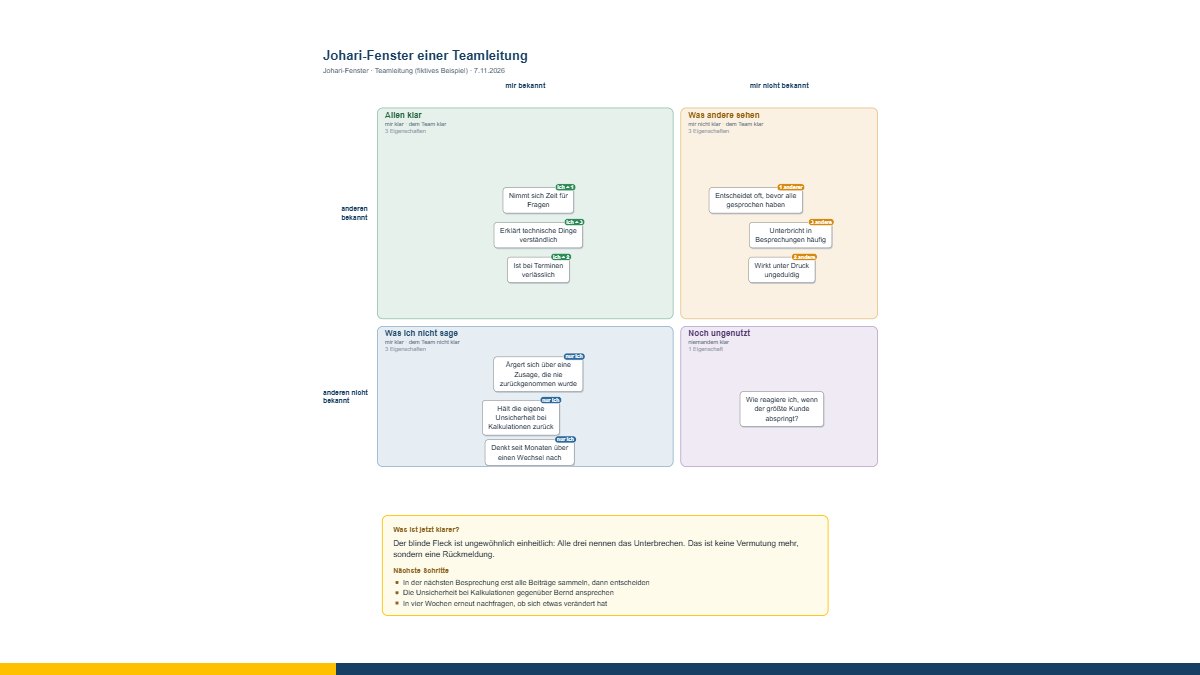
Many people know the Johari window as a diagram with four equally sized quarters. That is exactly its problem: in the rigid grid all four fields look equally important, and the blind spot – the genuinely interesting one – stays a box like any other. In the new Johari tool it is different: the fields grow with what they hold, and the field a quality belongs to does not follow from a gut feeling but from who names it.
What the size of the fields tells you
The built-in example is about a team leader. The open field holds three qualities, the blind spot likewise three, the hidden field three, the unknown one. The window therefore does not look like four quarters but like four differently sized areas – and that is precisely the finding.
If the hidden field is larger than the open one, it means more is left unsaid than said. Every quality you tell from there enlarges the open field – and makes working together easier. If the blind spot is large, it does not mean someone is blind; it means there is a lot of feedback that has not yet arrived.
Several outside assessments – and why that makes the difference
A single piece of feedback is an opinion. But if all three colleagues name the same quality – in the example, frequent interrupting in meetings – then it is no longer an assumption. That is why you enter several names for each quality; the card then shows “I + 2” or “3 others”.
Incidentally, feedback should be discussed with examples, not with judgements: “in Monday's meeting you interrupted me three times” is something completely different from “you are domineering”. The first sentence can be changed, the second only denied.
Ground rules
A Johari window only works voluntarily. Nobody has to tell anything from the hidden field, and nobody may enter feedback against the will of the person concerned. What stands in the window belongs to the person it is about – not to the team and not to the management. Anyone who uses it as an appraisal instrument has misunderstood it and damages the trust it depends on.
That is why it is a reflection and conversation model, not a diagnostic instrument: it records feedback and does not measure personality. Coaching is not psychotherapy (§ 1 (3) of the German PsychThG).
“Does not fit” is not an error
If you place a card by hand into a different field from the one the assessments produce, the tool marks it “does not fit”. That is deliberate – and it is not an error message. Sometimes the position is right and the entry is not: someone says “yes, I see this in myself”, yet still puts the quality in the blind spot, because while entering it they notice that they have only seen it since the conversation. Moments like that are exactly the yield.
Your data stays with you
The tool transmits nothing; it saves as a file *.johari.json. Merely opening the tool stores nothing in the browser. Exports: PDF, PowerPoint, LibreOffice Impress, Visio, SVG, PNG, a record and CSV.
Please bear in mind: this file holds assessments about a named person and the names of those who gave them. Treat it confidentially and pass it on only with consent.
The Johari tool is free of charge: open the Johari window. The model goes back to Joseph Luft and Harrington Ingham (1955); the guiding questions and notes are my own wording. If you would like to introduce feedback in your team without it turning into a reckoning, I am happy to support you – get in touch for a free initial consultation.
Open or download the tool
- Johari window (self-assessment and outside assessment)Open Download (454 KB)
Thinking further
You can find more on this topic under resources and downloads – or talk to me directly in a free initial consultation.
Comments
Comments are published immediately with your name. Only the name, title, comment text and time are stored – see the privacy policy.
Loading comments …