
This article was created with the AI assistant Claude and published by Peter Hoenig.
“Just ask why five times” sounds like a technique that needs no tool. And so it is – until the third why. After that two things reliably happen: the chain branches, because one step has more than one cause, and sooner or later an answer points at a person. Both decide whether the analysis is worth anything.
Five is a guide, not a law
Sometimes three steps are enough, sometimes it takes seven. The measure is not the number but the kind of answer: as long as it points at a symptom, you keep going. As soon as it points at a process or a rule, you have arrived.
An example from a production plant – invented, but most of them follow this pattern:
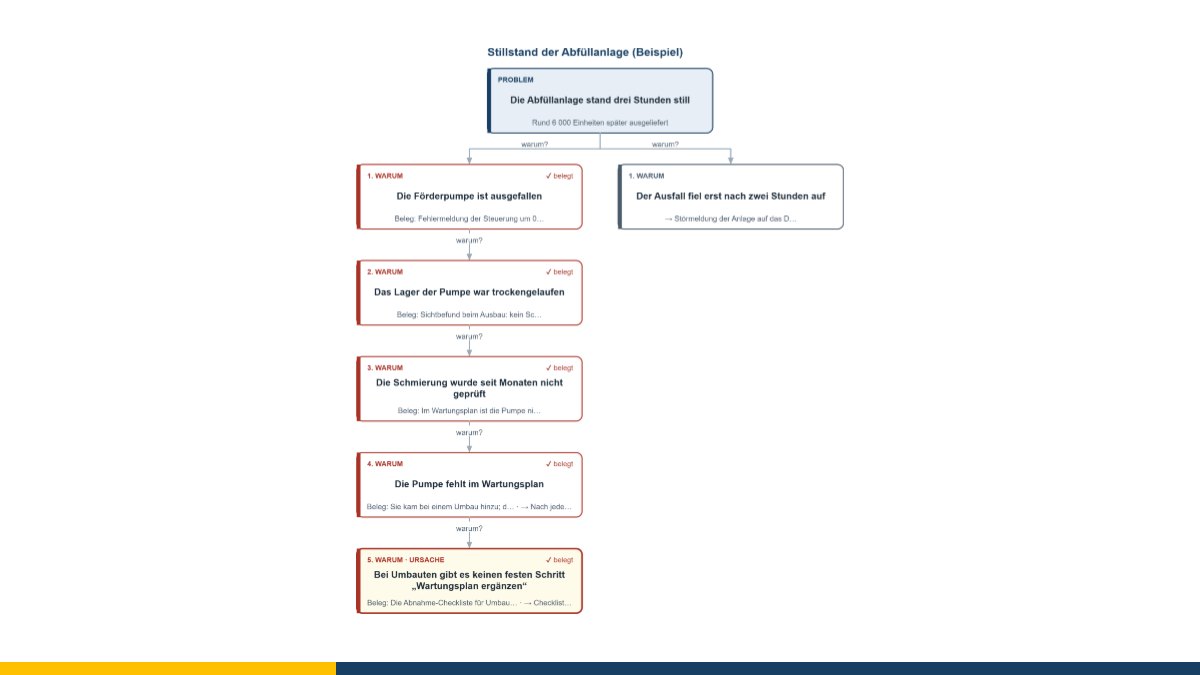
- The filling line stood still for three hours. Why?
- The feed pump failed. Why?
- The bearing had run dry. Why?
- Lubrication had not been checked for months. Why?
- The pump is missing from the maintenance plan. Why?
- When equipment is modified, there is no fixed step “update the maintenance plan”.
Only the sixth answer is a cause you can do something with – an item on the acceptance checklist. Had you stopped after step two, you would have replaced a pump and seen the same thing again in two years.
Evidence keeps the chain honest
Every step has a field “how do we know that?”. It sounds like bureaucracy and it is the difference between an analysis and a story. “Visual inspection on removal: no lubricant film, running marks” is something other than “the bearing was surely dry”. Only with evidence can you later decide where the chain bends – and where to take another look.
When the answer points at a person
This is the most important point, and the tool flags it. If an answer reads “because Mr X forgot”, the chain is not finished. It is standing at its most dangerous spot.
The next question is then not “why did he forget?” but:
What made the forgetting possible – and what should have caught it?
The difference is not politeness but effectiveness. A cause that could only be removed by different behaviour from individual people is not a cause, it is a hope. People forget things; that is not an exception but a constant. A process that relies on error-free people is itself the error.
And by the way: once somebody has been named in a review, you will learn noticeably less at the next incident. Blame-free questioning is therefore not merely decent, it is the precondition for getting any information at all.
Several strands are welcome
A single chain tempts you to settle on the first explanation. In reality a step often has two causes that are both true. “Strand alongside” creates a second branch at the same level, and the picture forks. In the example above a second strand belongs next to the pump: the outage was only noticed after two hours. That has nothing to do with the pump – and it cost half the downtime.
Where it comes from and where it goes
The five whys rarely stand alone:
- From the cause-and-effect diagram a collected cause arrives as the starting point – the diagram says where to look, the chain says how deep.
- From the incident timeline an outage arrives with its sequence of events as the problem.
- The finished chain with its measures goes out into the knowledge base of the ITSM tool.
For interwoven causes that reinforce each other the right tool is the causal loop diagram instead – a chain reaches its limit there.
The five whys tool is free of charge and available as free software under the GPL: open the five whys. If the same problems keep coming back in your company, I am happy to look at them with you – get in touch for a free initial consultation.
Open or download the tools
- Cause-and-effect diagram (Ishikawa, fishbone)Open Download (436 KB)
- Incident timeline and reviewOpen Download (444 KB)
- ITSM tool (incidents, problems, changes)Open Download (992 KB)
- Impact network editorOpen Download (473 KB)
- Five whys (chain of causes)Open Download (433 KB)
Thinking further
You can find more on this topic under process management consulting – or talk to me directly in a free initial consultation.
Comments
Comments are published immediately with your name. Only the name, title, comment text and time are stored – see the privacy policy.
Loading comments …