
This article was created with the AI assistant Claude and published by Peter Hoenig.
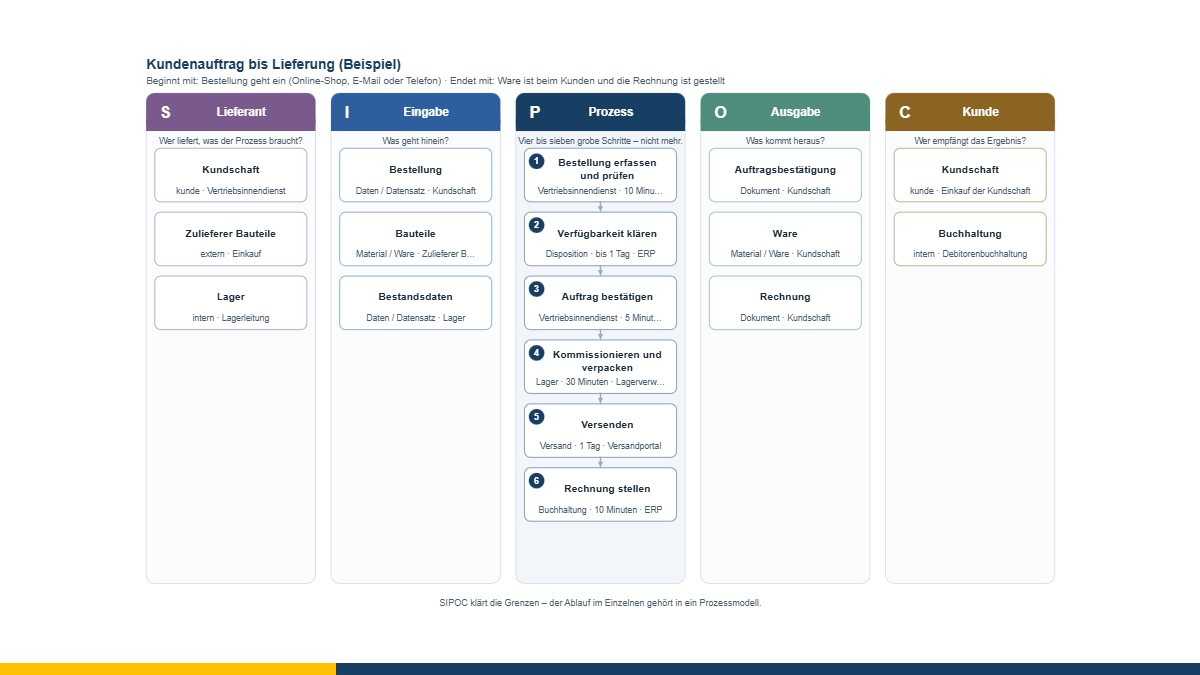
Process projects rarely fail at the modelling. They fail because everybody uses the same name and means a different stretch of work. Sales thinks “order handling” covers everything up to the order confirmation, the warehouse thinks it starts at picking, and accounts is waiting for an invoice that appears in neither picture. Three weeks into the modelling, that comes to light.
A SIPOC prevents it in half an hour.
Work from the inside out
Most people start on the left and do not get far, because “who supplies something?” is hard to answer without the process. It works better the other way round:
- Settle start and end. “Begins with: an order arrives. Ends with: the goods are with the customer and the invoice has been issued.” Two sentences that often take twenty minutes of discussion – rightly so, because afterwards everybody is talking about the same thing.
- Four to seven coarse steps in the middle. No more.
- Output and customer on the right: what comes out, who receives it?
- Input and supplier on the left: what goes in, from whom?
It is no accident that the outer columns come last. They fall into place easily once the middle is settled.
The uncomfortable column
The most interesting column is the last one. “Who is the customer of this process?” is a harmless question with an often uncomfortable answer. In many companies the real customer of an internal process is another department that has never been asked what it actually needs. The SIPOC makes that visible without accusing anyone – there is simply an empty column.
Almost as useful is the requirement field on every output. “Invoice” is not a requirement. “Factually correct, with all mandatory details, on the day of despatch” is one. Only then can you say whether the process is working.
Why no more than seven steps
Anyone writing down ten steps has already started modelling – and loses exactly the overview this is about. A SIPOC is the common understanding before the work, not its result. It shows neither branches nor exceptions, neither times nor volumes. That is deliberate.
For the detailed sequence there are process models; the 8EM modeller offers BPMN, event-driven process chains and SeeMe. The process frame from the SIPOC can be handed over there as a table – the process with its steps lands in level 6, suppliers and customers as organisations in level 7a. The other way round, the tool fetches an existing process with its sub-steps from a model file; you add suppliers and customers in the workshop.
Two checks worth having
The tool reports two things that experience shows get left out:
- An input with no matching supplier in the first column (or an output with no customer in the last). Usually somebody really is missing from the picture.
- An output with no requirement. Then nobody knows when the process has done its job.
If both are clean and start and end are settled, the group has cleared up more in half an hour than in the three weeks before.
The SIPOC tool is free of charge and available as free software under the GPL: open SIPOC. If you would like to put your processes in order and settle the interfaces to the outside world at the same time, I am happy to help – get in touch for a free initial consultation.
Open or download the tools
- 8EM modellerOpen Download (3.3 MB)
- SIPOC (clarify the boundaries of a process)Open Download (424 KB)
Thinking further
You can find more on this topic under process management consulting – or talk to me directly in a free initial consultation.
Comments
Comments are published immediately with your name. Only the name, title, comment text and time are stored – see the privacy policy.
Loading comments …