
This article was created with the AI assistant Claude and published by Peter Hoenig.
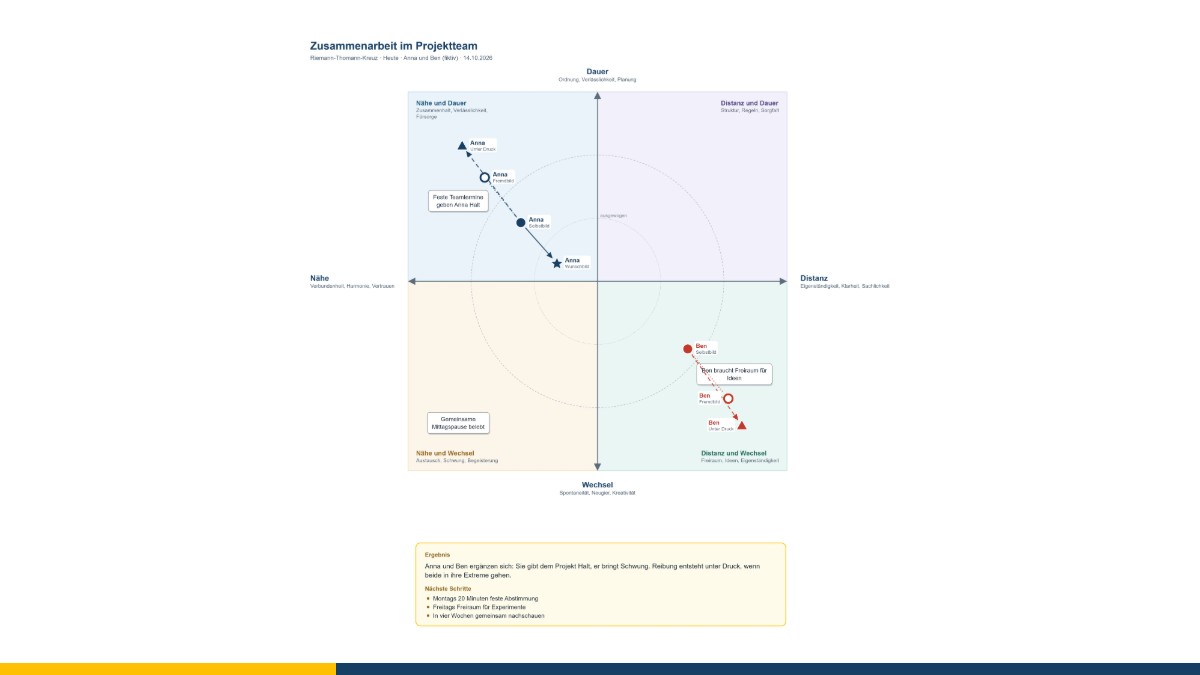
One person needs fixed routines, another loves spontaneous change. One seeks exchange, the other prefers to work alone. Differences like these often lead to friction in teams and partnerships – and yet they are also a strength, because they complement each other. The Riemann-Thomann cross gives these differences a framework in which they can be discussed without blame.
At a glance
- The model describes four basic needs on two axes: closeness and distance, permanence and change.
- Everyone carries all four within them – to differing degrees.
- It goes back to Fritz Riemann and was developed further by Christoph Thomann for clarification work (Klärungshilfe).
- The free Riemann-Thomann editor shows self-image, image held by others, desired image and behaviour under pressure.
The aim of the method
The horizontal axis runs from closeness (connection, harmony, trust) to distance (independence, clarity, objectivity), the vertical axis from permanence (order, reliability, planning) to change (spontaneity, curiosity, creativity). Where someone stands in the cross says nothing about right or wrong – only about what matters most to him or her. The further out, the stronger the tendency; the centre represents a balance.
It gets interesting when you compare: How do I see myself, how do others see me? Where would I like to be? And where do I slide to under pressure – usually further in my own direction, until a strength turns into an exaggeration? In a team, the cross shows why two people rub each other up the wrong way and helps to find agreements that do justice to both.
Where the method comes from
In his 1961 book “Grundformen der Angst” (Basic Forms of Anxiety), the psychoanalyst Fritz Riemann described four fundamental human strivings that stand opposite each other as pairs. Together with Friedemann Schulz von Thun, the Swiss psychologist Christoph Thomann shaped this into a model for clarification work (Klärungshilfe) that makes conflicts understandable as an expression of differing needs. It became known above all through Schulz von Thun’s communication psychology.
How to work with the cross
- Explain the four poles – with examples from everyday life.
- Mark the self-image: Where do I stand?
- Add further perspectives: this is how others experience me, this is where I want to be, this is how I react under pressure.
- Compare in a team or as a pair: Where do we complement each other, where do we clash?
- Make agreements that take everyone’s needs into account.
Working with the Riemann-Thomann editor
- Markers: drag self-image, image held by others, desired image and “under pressure” onto the cross and label them with a name. Lines connect the markers of one person; the position is shown alongside in words and as a percentage.
- Observations: cards in each field for needs, strengths or points of conflict.
- Exaggerations: if you wish, the poles show what a strength turns into when it is overdone.
- Templates: one person, and team or two people in conversation.
- Several pictures: for example the current situation and an agreement within the team; the record shows the changes.
- Saving and export: save as a file, printable record, export as PDF, PowerPoint, LibreOffice Impress, Visio, SVG, PNG and as a table for Excel.
The editor runs entirely in your browser and does not transmit any data. Please record assessments of other people only with their consent. The editor is free of charge and available as free software under the GPL: Open the Riemann-Thomann editor in your browser.
In coaching, the Riemann-Thomann cross serves as a model for reflection and dialogue about basic needs, not as a personality diagnosis. Coaching does not replace psychotherapy.
Conclusion
If you know the needs behind a behaviour, you can see differences as complementary rather than disruptive. If you would like to resolve conflicts within your team or strengthen collaboration, I will be glad to support you with conflict management and team development. Get in touch for a free initial consultation.
Sources: Riemann, F. (1961): Grundformen der Angst. Munich: Reinhardt. – Thomann, C.; Schulz von Thun, F. (1988): Klärungshilfe. Reinbek: Rowohlt. – Schulz von Thun, F. (1989): Miteinander reden 2. Stile, Werte und Persönlichkeitsentwicklung. Reinbek: Rowohlt.
Thinking further
You can find more on this topic under resources and downloads – or talk to me directly in a free initial consultation.
Comments
Comments are published immediately with your name. Only the name, title, comment text and time are stored – see the privacy policy.
Loading comments …