
This article was created with the AI assistant Claude and published by Peter Hoenig.
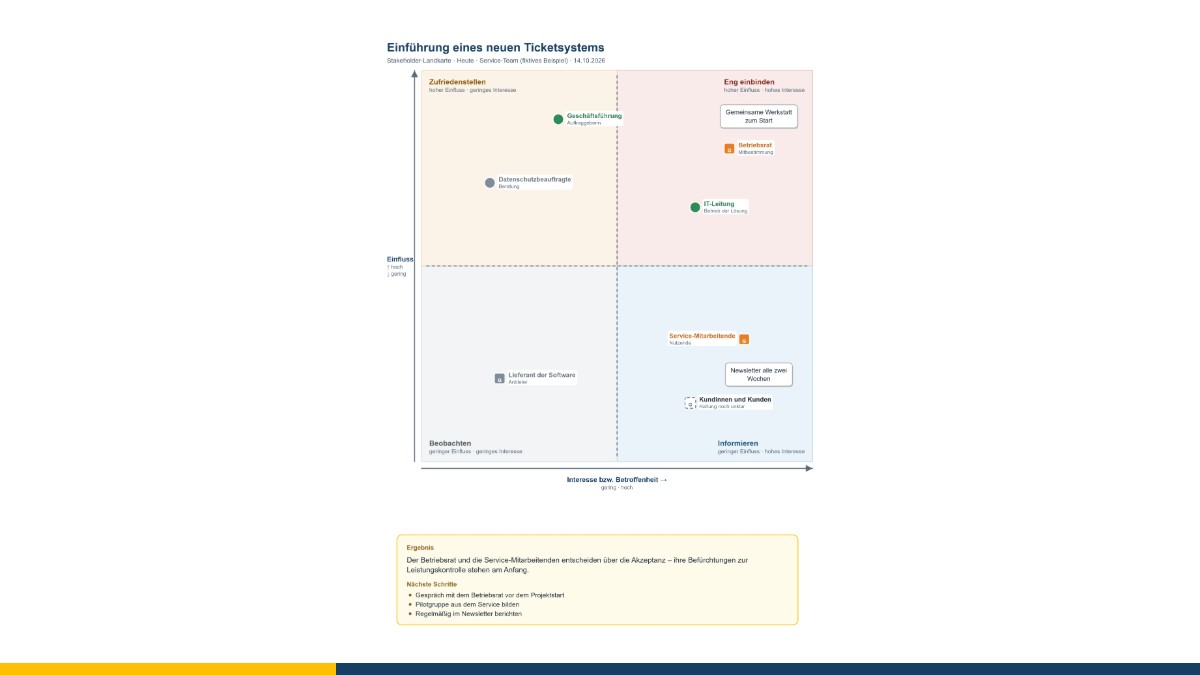
Whether it is new software, a move or a restructuring: every initiative affects people who are not on the project team – senior management, the works council, the service staff, customers, suppliers. Some of them can advance or stop the initiative; others mainly have to live with its consequences. The stakeholder map helps you keep them all in view and decide deliberately whom to involve and how.
At a glance
- The map arranges stakeholders by their influence and by their interest or how strongly they are affected.
- This results in four strategies: involve closely, keep satisfied, keep informed, monitor.
- Colours show each stakeholder's attitude towards the initiative – from supportive to opposed.
- A target picture shows where attitudes and involvement should develop.
- The free stakeholder editor brings together the map, concerns and actions.
Purpose of the method
If you involve the people affected early on, you learn about their concerns while there is still time to change something – and you often gain allies. If you pass them over, you usually only encounter resistance once it becomes expensive. The map shows where attention is needed: who has a lot of influence and is strongly affected? Who is strongly affected but has hardly any influence – and therefore needs particularly reliable information? Where are there critical voices with whom a conversation would be worthwhile?
Where the method comes from
The term “stakeholder” became established in management studies above all through R. Edward Freeman, who argued in 1984 that companies should take into account not only their owners but everyone with a stake in them. The grid of influence and interest is often traced back to Aubrey Mendelow and is widely used in project management and change management today. The names of the fields and the strategies in my editor are my own wording.
How to create a stakeholder map
- Collect all stakeholders – individuals and groups, internal and external.
- Assess their influence and their interest or how strongly they are affected, and place them on the map.
- Mark their attitude towards the initiative: supportive, neutral, critical, opposed or still unclear.
- For each stakeholder, record concerns, worries and a suitable action – and who will take care of it.
- Draft a target picture: where should the stakeholders be at the end?
- Review the map regularly as the initiative progresses.
Working with the stakeholder editor
- Map: drag stakeholders with their attitude onto the canvas and name them; groups appear as squares. Their position is shown alongside in words and as a percentage, together with the strategy for that field.
- Description: role, concerns, worries, action and person responsible for each stakeholder.
- Templates: project or initiative, and organisation.
- Today and target picture: a copy of the picture shows where attitudes and involvement should develop; arrows make the change visible.
- Saving and export: save as a file, a printable report with all stakeholders, concerns and actions, export as PDF, PowerPoint, LibreOffice Impress, Visio, SVG, PNG and as a table for Excel.
The editor runs entirely in your browser and does not transmit any data. Please bear in mind: assessments of individual people are personal data – name individuals only where necessary, and treat the file confidentially. The editor is free of charge and available as free software under the GPL: Open the stakeholder editor in your browser.
The stakeholder map reflects assessments, not judgements of people. It is a model for reflection and dialogue.
Conclusion
If you know your stakeholders, you plan change together with people rather than going over their heads. If you are setting up or supporting an initiative, I will be glad to help you with project support and business change management. Contact me for a free initial consultation.
Sources: Freeman, R. E. (1984): Strategic Management. A Stakeholder Approach. Boston: Pitman. – Mendelow, A. (1991): Stakeholder Mapping. Proceedings of the 2nd International Conference on Information Systems, Cambridge, MA.
Thinking further
You can find more on this topic under resources and downloads – or talk to me directly in a free initial consultation.