
This article was created with the AI assistant Claude and published by Peter Hoenig.
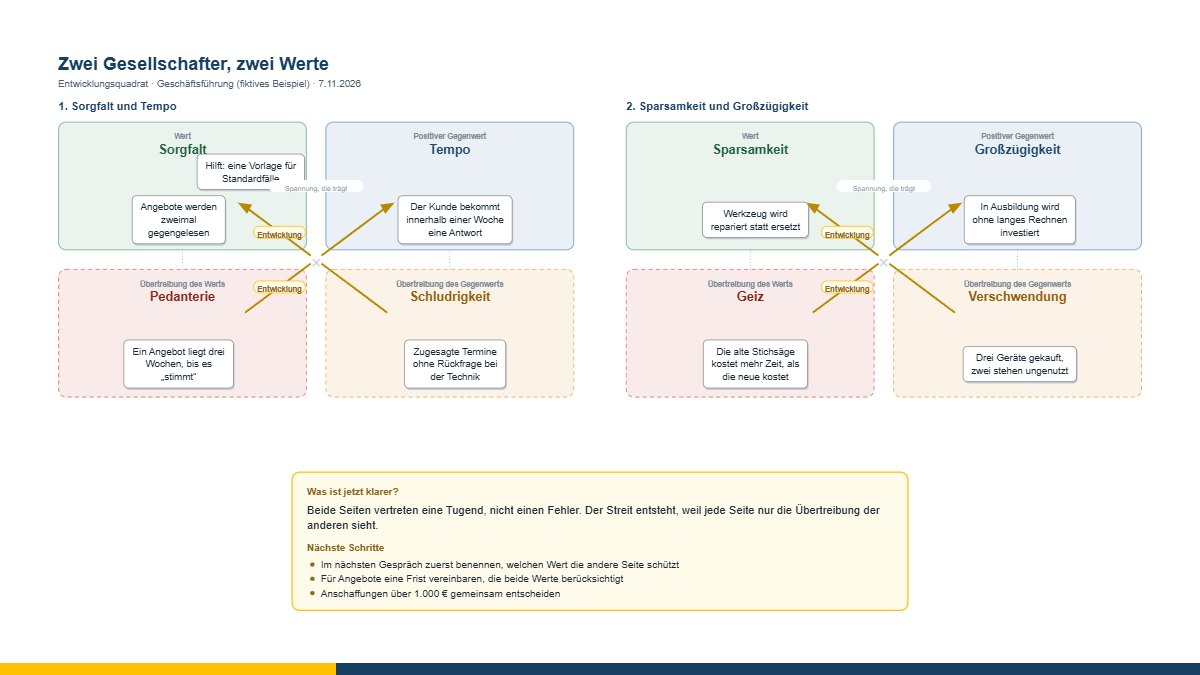
“He is simply pedantic.” – “And she is sloppy.” When two people describe each other like that, the conversation is usually over before it has begun. The values and development square after Friedemann Schulz von Thun turns the direction of view around: it asks not which fault lies behind the behaviour, but which value. And it shows that development does not go where you would assume.
Why the arrows run diagonally
This is where the model differs from any self-help wisdom. Someone stuck in an exaggeration does not develop back towards their own value. “A little less miserly” helps nobody – it is not even a direction, just a toning down.
The direction of development is diagonal: from miserliness to generosity, from wastefulness to thrift. And it has a limit. Go too far and you land in the next exaggeration – generosity turns into wastefulness, and the game starts again with the roles swapped.
That sounds theoretical but is immediately usable in conversation. It takes the moral undertone out of change: it is not about being less bad, but about learning a second virtue.
What it achieves in an argument
In the built-in example two business partners are at odds. The first square is called “care and speed”: one of them reads every quote twice, the other wants the customer to have an answer within a week. In everyday work each sees only the other's exaggeration – a quote that has been sitting for three weeks, and dates promised without checking with the workshop.
The square shows what both really stand for: care and speed. Two virtues, not faults. The argument arises because each side sees only the other's exaggeration – and takes its own for sensible moderation.
So the first question in the conversation is not “how can we agree?” but: which value is the other side protecting? Anyone who can say that out loud has not yet solved the conflict, but has taken it out of the drawer marked “character flaw”.
How to work with it
The easiest start is not with the value but with the exaggeration that bothers you in everyday work – everyone has that to hand at once. Then look for the value behind it, then the counter-value, then its exaggeration. In that order the square fills itself almost by itself.
In each field you then collect cards: sentences that were actually said, observations, and above all what helps. With “+ Another square” you create as many further squares as you like – in a conflict often one for each side, because both sides bring their own values.
What the tool is not
A reflection and conversation model, not a diagnostic instrument. It describes values, not people. Nobody “is” a quadrant. And coaching is not psychotherapy (§ 1 (3) of the German PsychThG).
The model goes back to Friedemann Schulz von Thun, building on Nicolai Hartmann and Paul Helwig. The guiding questions, notes and examples in the tool are my own wording.
Your data stays with you
The tool transmits nothing; it saves as a file *.entwicklungsquadrat.json wherever you want it. Merely opening the tool stores nothing in the browser. Exports: PDF, PowerPoint, LibreOffice Impress, Visio, SVG, PNG, a record and CSV.
The development square is free of charge: open the development square. If two sides in your company are at loggerheads and both are right, I am happy to support you – get in touch for a free initial consultation.
Open or download the tool
- Values and development square (after Schulz von Thun)Open Download (449 KB)
Thinking further
You can find more on this topic under resources and downloads – or talk to me directly in a free initial consultation.
Comments
Comments are published immediately with your name. Only the name, title, comment text and time are stored – see the privacy policy.
Loading comments …