
This article was created with the AI assistant Claude and published by Peter Hoenig.
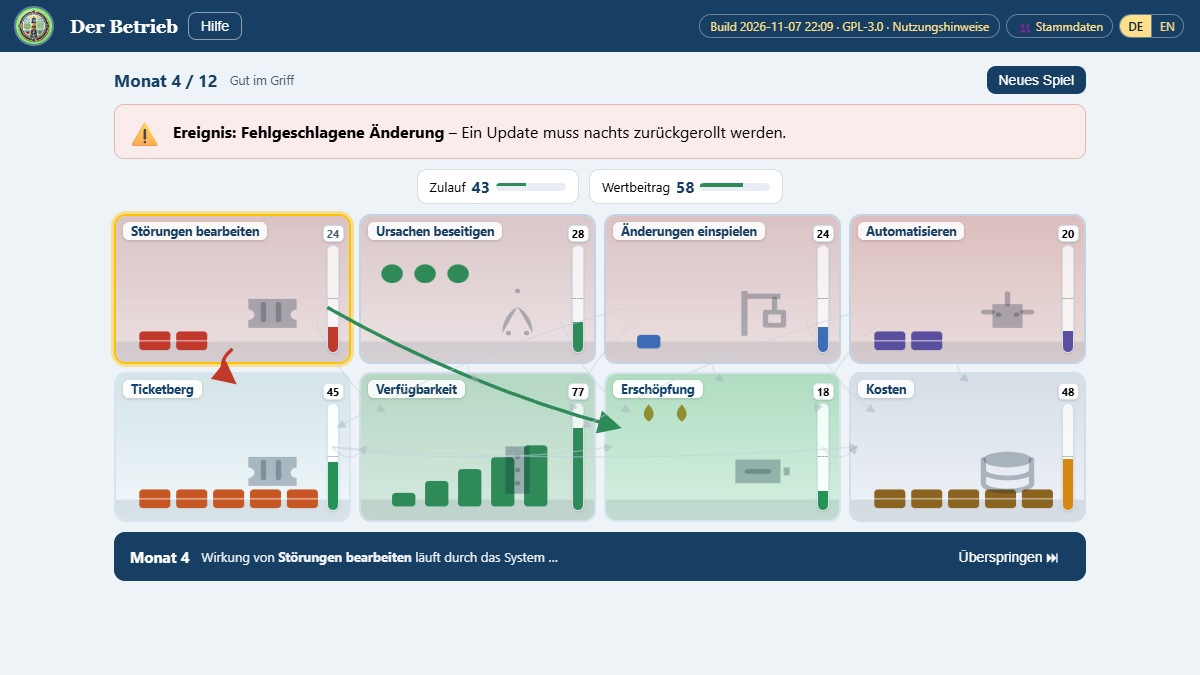
There is a sentence I hear again and again in IT teams: "We simply have no time for root causes right now." It is entirely understandable, and it is the reason why nothing about the situation changes. Operations turns that into a game: twelve months, a small team, four levers that share the same capacity. In your browser, free of charge, with nothing transmitted.
The backlog is a stock, not a number
In the game the ticket backlog is what it really is: a stock. It grows with the inflow and shrinks with the processing. Anyone who only processes changes only the second half of that equation – and the inflow keeps rising by itself if nobody removes the causes. That is how a team can work harder and harder for a year and end up facing a bigger backlog than at the start. This is not laziness and not an organisational failure, it is arithmetic.
On top of that comes the second loop: handling incidents at full throttle exhausts the team. An exhausted team has less capacity and achieves less per unit of effort. So anyone who firefights permanently reaches a point where they can no longer keep up despite working flat out. In the game that ends with two resignations.
Why the obvious strategy fails
The obvious strategy is to work the backlog down – calm first, everything else later. In the game that produces a mediocre result on the easiest level and no result at all on the hardest. The strategies that win look different: firefight only as much as the team can carry, and put the rest into root cause work and automation. That means living with a growing backlog for two or three months without losing your nerve. In practice that is the actual leadership task.
And what about the changes?
The fourth lever is the one you most easily forget while tidying up: delivering. Operations that only administer themselves lose their justification – which is why the game counts a separate value delivered. But deploying changes creates new incidents if there is too little quality behind them, and quality comes from automation, root cause work and a team that has room to breathe. Deliver in chaos and you enlarge the chaos.
Who is this for?
For IT managers and service desk leads who have to explain to their management why more hours do not help. For teams who want to watch themselves from the outside for once. And as a way into a conversation about IT service management – along the lines of the ITIL® way of thinking, but without a certificate and without a slide battle.
In short
Free as free software, independently implemented: Open Operations. How networked thinking works I explain with no prior knowledge in Networked thinking – why simple cause and effect often leads you astray. If the same incidents keep coming back in your organisation year after year, do get in touch for a free initial consultation.
"Operations" is a simplified learning and thought model, not a forecasting tool and not a method. ITIL® is a trademark of AXELOS/PeopleCert and is mentioned here descriptively only.
Open or download the tool
- Der Betrieb (Simulationsspiel)Open Download (322 KB)
Thinking further
You can find more on this topic under Ressourcen und Downloads – or talk to me directly in a free initial consultation.