
This article was created with the AI assistant Claude and published by Peter Hoenig.
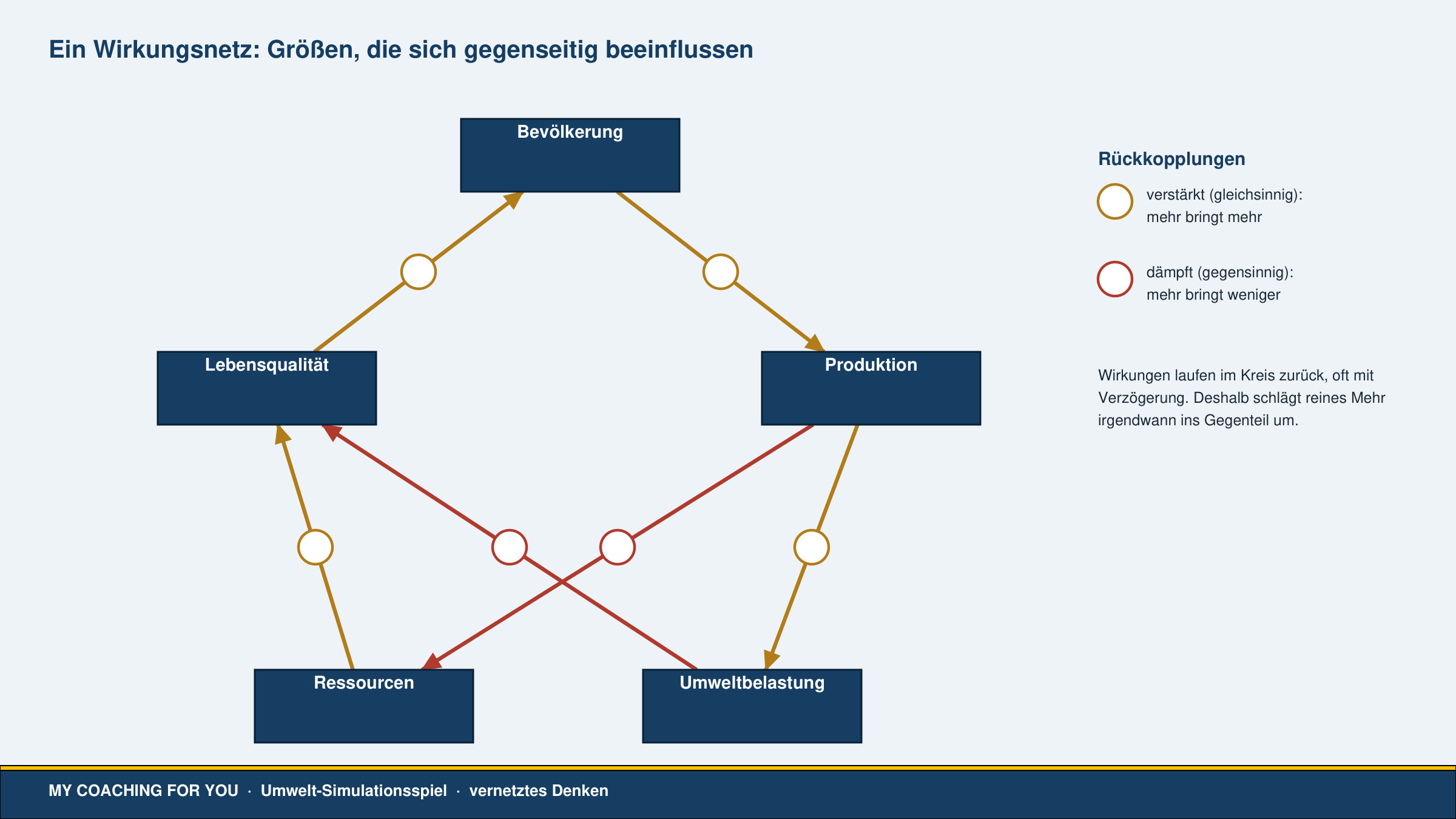
My environment simulation game looks harmless: a few sliders, a few numbers, twelve years. And yet it leaves many people puzzling – because it does not behave the way you would expect. That is exactly the point. This post explains, for everyone without prior knowledge, what it is all about: networked thinking. It is not specialist knowledge for experts, but a way of thinking that helps again and again in everyday life and in the company.
The reflex: one cause, one effect
We are used to thinking in straight lines: I press the light switch, the light comes on. I raise the price, the revenue per unit goes up. I hire more people, more gets done. In many cases that is quite true – as long as things are simple and manageable.
It becomes difficult as soon as several quantities are connected and influence one another. Then every decision has not only the one intended effect, but a whole series of side effects – some immediately, some only much later. Anyone who keeps thinking in straight lines will be surprised again and again.
What makes something a "system"
A system is nothing mysterious: it is several quantities connected to one another through effects. A pond with fish, plants and nutrients is a system. A family is one. A company with its departments, customers and suppliers all the more so. Three properties make systems so treacherous for our thinking:
- Feedback loops. An effect runs in a circle back to its cause. There are reinforcing feedback loops – more leads to still more, like compound interest or a rumour that builds up. And there are balancing feedback loops – something settles back down, like the heating that switches off once the desired temperature is reached.
- Delays. There is often time between cause and effect. If I fertilise today, the plant grows next week. If I cut back on maintenance, the machine breaks down in six months. Because we do not see the delay, we tend to overcorrect – and then overcorrect too far in the opposite direction.
- Side effects. An intervention in one place takes effect somewhere quite different. More production brings affluence and environmental burden – the two belong together, whether you want it or not.
Networked thinking simply means: taking these three things into account, instead of only the one straight line.
The game as a hands-on thought model
That is exactly what you can experience in the environment simulation game. You "govern" a small, heavily simplified country over twelve years. You steer four levers yourself with action points: Remediation (environmental protection), Production (the economy), Education (schooling and technology) and Quality of life (health and social affairs). Four further quantities emerge from that on their own: Politics (your political support, which determines how many action points you have), Environmental burden, Reproduction rate and Population – together with affluence, resources and technology.
If you put everything into production, affluence rises at first – but the environmental burden follows, resources dwindle, and a few years later the situation tips over. If you only remediate, the environment stays clean, but you lack the strength for everything else. There is no single right lever; it is about keeping the whole in balance – and enduring the delays until a decision takes effect.
The models behind it – explained simply
The game is deliberately simplified, but it picks up well-known ideas. Four of them are worth knowing, because they reach far beyond the game.
The Limits to Growth (World3, 1972). In 1972 a research team around Donella and Dennis Meadows published the study "The Limits to Growth" on behalf of the Club of Rome. Their computer model World3 showed: if population and production grow unchecked, they run into natural limits – and because feedback loops take effect with a delay, the system does not slow down gently, but overshoots and collapses ("overshoot and collapse"). This very overshoot is something you can trigger in the game if you bet too hard on growth for too long.
Carrying capacity and logistic growth. Every environment can support only a limited amount – a pond only so many fish, a country only as many people as the environment and the economy can feed. Back in the 19th century the mathematician Pierre François Verhulst described how growth proceeds quickly at first and then approaches such a carrying capacity – the familiar S-curve. If the population exceeds the carrying capacity, collapses loom. In the game this is the reason why sheer "more" eventually turns into its opposite.
The demographic transition. Why does "Education" lower the birth rate in the game? Behind this stands a well-documented observation: with education, health and rising affluence, mortality falls first and later the birth rates too – societies pass through a transition from high to low rates. The game reproduces this relationship in simplified form.
The IPAT idea. How heavily a country burdens the environment depends roughly on three things: how many people there are, how much each one consumes and how clean the technology is. In short: Impact = Population × Affluence × Technology (the so-called IPAT formula). That is why in the game both remediation and education (better, more efficient technology) help to reduce the environmental burden without giving up all affluence.
The idea for the game: Vester and Ökolopoly. The form – playfully keeping a country with a few sliders in balance – goes back to the biochemist and systems researcher Frederic Vester (1925–2003), who wanted to carry networked thinking out of science into schools and companies. His learning game Ökolopoly (later as the computer game Ecopolicy) is continued today by the Malik group in St. Gallen. My game is inspired by it, but an independent implementation: my own presentation, my own numbers, my own code. All the models and names mentioned I mention only descriptively, to disclose the intellectual origin.
Why this matters in the company
What the country is in the game, the organisation is in working life. Here too, "straight lines" often lead you astray: a new control instrument is meant to raise quality – and above all produces more bureaucracy. A savings programme is meant to cut costs – and drives away the most experienced people. A piece of software is meant to speed up a process – and reveals that the process itself is the problem. And, as in the game, many of these consequences take effect only with a delay.
That is why my consulting does not begin with the individual tool, but with the connections. In the 8-Level Model (8EM) I look with you at how vision and goals, capabilities and processes, organisation and IT systems mesh together – and which feedback loops and side effects a planned change really has. The guiding question stays the same throughout: Does it serve people? The game is a small, playful entry point for that.
In short
Networked thinking is no secret science, but the habit of taking feedback loops, delays and side effects into account. The environment simulation game makes that tangible in a few minutes – free of charge and as free software: Open the environment simulation game. And if you want to understand and shape your company as a system, do get in touch with me for a free initial consultation.
This post explains basic ideas of networked thinking and the models mentioned in a heavily simplified form. The game is a learning and thought model, not a scientific forecasting tool.
Thinking further
You can find more on this topic under Ressourcen und Downloads – or talk to me directly in a free initial consultation.