
This article was created with the AI assistant Claude and published by Peter Hoenig.
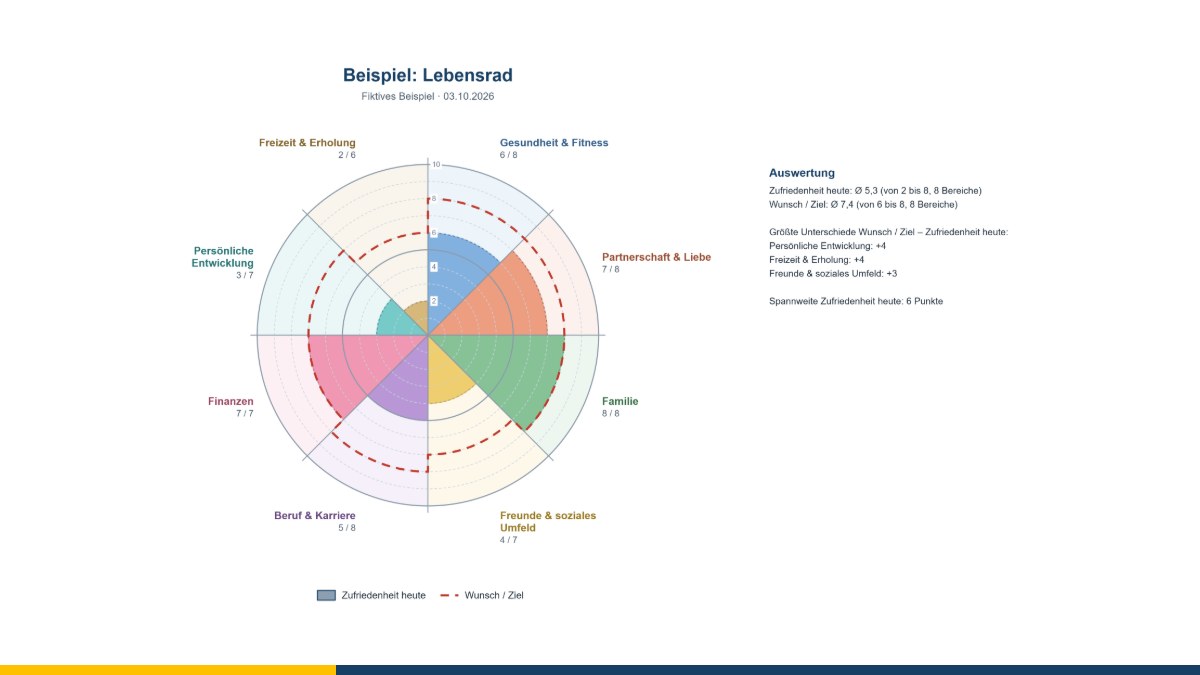
Is my life running smoothly? The wheel of life takes this question quite literally: the areas of life form the spokes of a wheel, and your satisfaction in each area is entered as a value. The result shows at a glance where things are running smoothly and where the wheel is bumping along. The role wheel applies the same principle to the many roles we take on in life. Two related forms complement it: the time pie, which shows where your time actually goes, and the team clock, on which a team assesses which phase of its development it is currently in.
At a glance
- The wheel of life shows satisfaction in several areas of life, for example on a scale from 0 to 10.
- The role wheel compares roles by satisfaction, share of time and importance.
- The time pie places the current and the desired distribution of time side by side.
- The team clock collects the assessments of all team members on the phases of team development according to Bruce Tuckman.
- The free wheel of life editor draws all four forms from your values and compares “today” and “desired”.
Aim of the method
The wheel of life helps you gain an overview before going into detail. It does not show how life “should be”, but how you yourself are experiencing it right now. Comparing two series of values is particularly revealing: How satisfied am I today – and where do I want to get to? The biggest differences are often a good starting point for coaching.
The role wheel turns the spotlight on roles such as manager, partner, mother or father, friend. It gets interesting when share of time and importance diverge: Which role takes up a lot of time but is actually not that important to me? Which one gets too little attention?
The time pie makes this question tangible: How many hours a week go into work, family, friendships, health or rest – and what would the distribution I want look like? Because the slices always add up to a whole pie, it becomes clear that more time for one thing means less time for something else.
The team clock transfers the principle to teams. Each member places a marker on the clock face: Where does our team stand today – and where do we want to be? Differing assessments are not a mistake but a good starting point for conversation.
Where the method comes from
The wheel of life is often attributed to the American entrepreneur Paul J. Meyer, who developed programmes on goal-setting and self-development in the 1960s. There is no definitive source; the method has spread in many variants in coaching and self-management.
A related model comes from the physician and psychotherapist Nossrat Peseschkian, the founder of Positive Psychotherapy: in the 1970s he described four areas of life – body and health, achievement and work, contact and relationships, meaning and future – which should be in balance. This balance model is included in the editor as a template.
The team clock is based on the phase model of the American psychologist Bruce W. Tuckman. In 1965 he summarised studies of small groups in four phases – forming (orientation), storming (conflict), norming (agreement) and performing (achievement); in 1977, together with Mary Ann C. Jensen, he added the adjourning phase (closure). Depicting the phases as a clock is common in the German-speaking world.
How to use the wheel of life
- Define the areas of life – for example health, partnership, family, friends, work, finances, personal development, leisure.
- For each area, assess your current satisfaction, for example from 0 (not at all satisfied) to 10 (completely satisfied).
- Connect the values – a more or less round wheel emerges.
- Add a second series: Where would I like to be in a year's time?
- Look at it together: What stands out? Which area influences the others most strongly? What would be a small first step – and which areas may deliberately stay lower?
Working with the wheel of life editor
- Templates: wheel of life with 8 or 10 areas, role wheel with satisfaction, share of time and importance, four areas of life according to Peseschkian, time pie, team clock or your own wheel with 3 to 16 areas.
- Setting values: Simply click or drag in the wheel – the distance from the centre is the value. Alternatively, type the values into the table.
- Several series: up to four series of values, such as “today” and “desired”, shown as a filled area, a line or a dashed line.
- Display: as pie slices, as a radar chart, as a time pie or as a clock; scale up to 10 or up to 5.
- Time pie: Enter hours per week, percentages or values without a unit; each series produces its own pie, with “today” and “desired” side by side.
- Team clock: Add people and set their assessment by clicking on the clock face – “today” and, if you wish, “desired”. The hand shows the centre of gravity of all assessments; for each phase there are tips on what can help.
- Analysis and guiding questions: average, range and largest differences between the series, and for the time pie the biggest shifts – purely descriptive. In addition, guiding questions and notes for each area.
- Saving and export: Save as a file, export as PDF, PowerPoint, LibreOffice Impress, Visio, SVG, PNG and as a table for Excel.
The editor runs entirely in your browser and does not transmit any data. It is free of charge and available as free software under the GPL: Open the wheel of life editor in your browser.
In coaching, the wheel of life, role wheel, time pie and team clock serve as models for reflection and dialogue, not as diagnostic instruments. The analysis only describes the values entered. Coaching does not replace psychotherapy.
Conclusion
The wheel of life is a simple and effective starting point: it shows where you stand and helps you set priorities. If you would like to develop concrete steps from it, I will be glad to accompany you in Personal Coaching; I also use the team clock in team development. Get in touch for a free initial consultation.
Sources: Peseschkian, N. (1977): Positive Psychotherapie. Frankfurt am Main: S. Fischer. – Tuckman, B. W. (1965): Developmental Sequence in Small Groups. Psychological Bulletin 63 (6), pp. 384–399. – Tuckman, B. W.; Jensen, M. A. C. (1977): Stages of Small-Group Development Revisited. Group & Organization Studies 2 (4), pp. 419–427.
Thinking further
You can find more on this topic under resources and downloads – or talk to me directly in a free initial consultation.