
This article was created with the AI assistant Claude and published by Peter Hoenig.
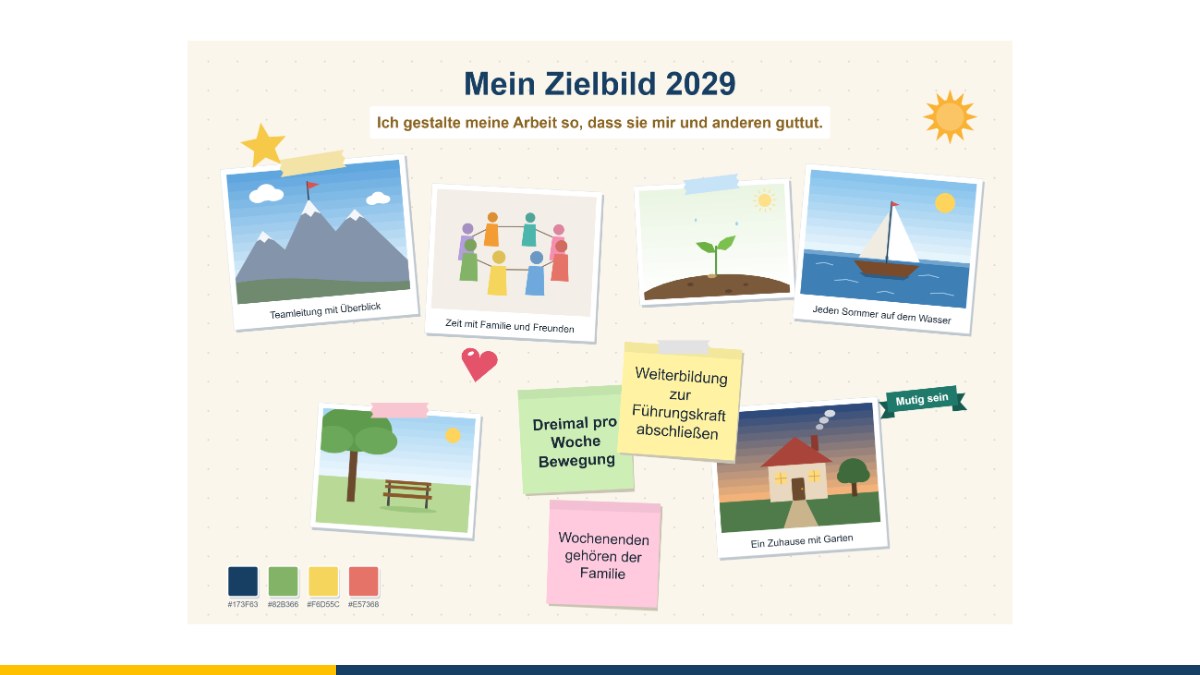
“What actually is my goal?” This question rarely has a clear answer straight away. A vision board – sometimes also called a mood board – approaches it from a different angle: with pictures, words and colours that show how a good life, a new role or a successful project should feel. The picture makes wishes tangible and helps you keep your direction in view.
At a glance
- A vision board is a collage of pictures, words and colours relating to a goal or an area of life.
- It does not work “by itself”, but it helps you clarify priorities and stay motivated.
- It is at its strongest when combined with an honest look at obstacles and concrete steps.
- The free vision board editor lets you create vision boards and mood boards with your own photos right in your browser.
The aim of the method
A vision board translates wishes into a form you can see. Even choosing the pictures is valuable: What appeals to me? What do I leave out? Which words fit? This makes it clear what really matters. If the picture later hangs at your workplace or serves as your screen background, it reminds you of your own direction in everyday life.
In coaching, I use vision boards for things such as career reorientation, a motto for the year or a team’s vision, or as a mood board for a project.
Where the method comes from and what research says
Collages and picture boards have long been used in art, design and education. Under the name “vision board”, the method became popular mainly through the self-help literature of the 2000s – often linked to the promise that wishes come true simply by visualising them. Research does not bear out this promise.
What it does show is more nuanced: the goal-setting research of Edwin Locke and Gary Latham demonstrates that clear and challenging goals improve performance. Gabriele Oettingen has shown that pure positive fantasising can even reduce motivation – it only becomes effective when you combine the wish with a realistic look at the obstacles and plan how to deal with them. A good vision board is therefore a starting point for concrete steps, not a substitute for them.
How to create a vision board
- Choose the scope: an area of life, a year, a project or life as a whole.
- Collect pictures, words and colours that feel right – without thinking about them for long.
- Select and arrange: What goes in the centre? What belongs together?
- Formulate a guiding statement that sums up the picture.
- Add honestly: What could hold me back? What will I do then?
- Decide on the first step – and put the picture where you will see it regularly.
Working with the vision board editor
- Your own pictures: drag them onto the canvas or paste them with Ctrl+V. Pictures stay in the picture bar and can be used more than once.
- Design elements: sticky notes, headings, guiding statements and words, 22 stickers designed for the editor (for example heart, star, target, rocket, clover leaf) and motifs. Each element can be rotated, enlarged and given a frame, tape or a shadow.
- Templates: areas of life around the centre; today – on the way – in three years; my year with a motto and seasons; me in the centre; work – private life; and mood board.
- Colours from the picture: for mood boards, the editor creates colour swatches with the main colours of a photo.
- Several boards: for example for work and private life, or as a copy to develop further – all in one file.
- Saving and export: save as a file; export as PDF (A4/A3), PNG – also in a “phone wallpaper” format –, PowerPoint, LibreOffice Impress, Visio and SVG.
You may use pictures from the internet for your personal vision board, but you must not publish or pass them on without permission. The editor runs entirely in your browser and does not transmit any data. It is free of charge and available as free software under the GPL: Open the vision board editor in your browser.
In coaching, the vision board serves as a method for reflection and dialogue, not as a diagnostic instrument. Coaching does not replace psychotherapy.
Conclusion
A vision board gives your wishes a shape and your everyday life a direction – especially when it leads to concrete steps. If you would like to develop your vision board together with me, get in touch for a free initial consultation.
Sources: Locke, E. A.; Latham, G. P. (1990): A Theory of Goal Setting and Task Performance. Englewood Cliffs: Prentice Hall. – Oettingen, G. (2014): Rethinking Positive Thinking. New York: Current (German edition: Die Psychologie des Gelingens, 2015).
Thinking further
You can find more on this topic under resources and downloads – or talk to me directly in a free initial consultation.