
This article was created with the AI assistant Claude and published by Peter Hoenig.
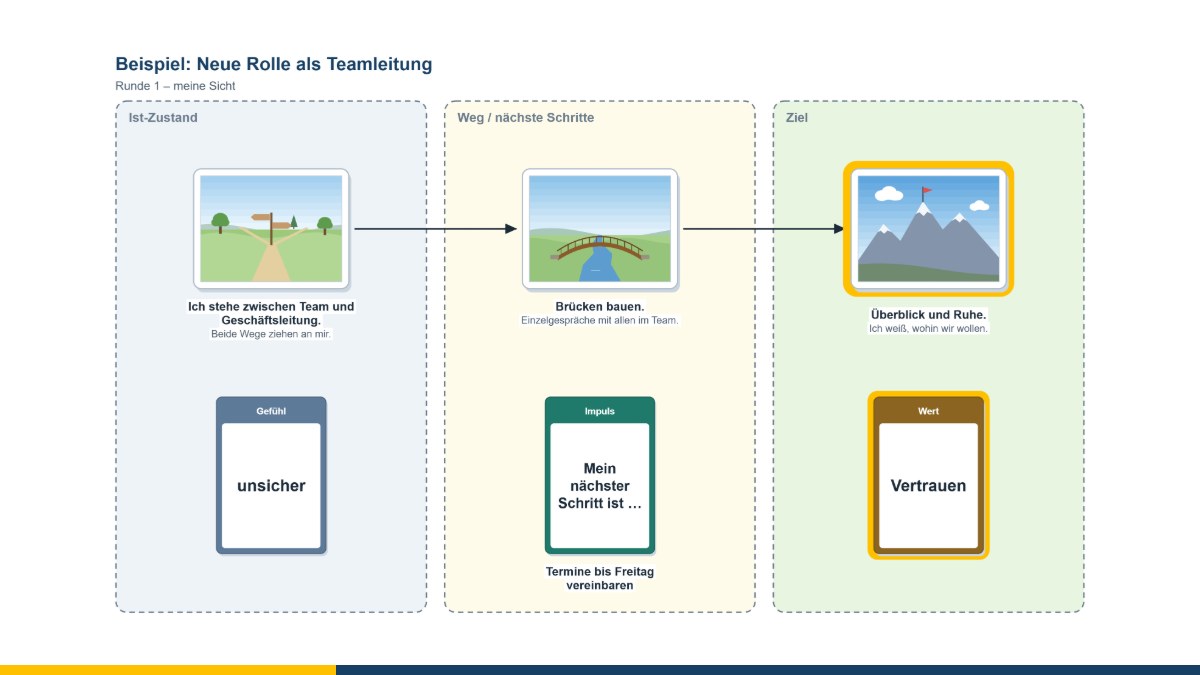
Sometimes words fail – and a picture finds them. In card work, people choose picture or text cards that match their situation, their goal or their feelings, and describe what they see in them. The card is merely the prompt: the meaning comes from the person themselves. That is what makes the method so versatile – for opening a conversation, for changes of perspective or for working on goals.
Aim of the method
Pictures speak to different levels than words do. A card showing a lighthouse, a bridge or a path in the fog invites you to describe your own situation in a picture: “This is how my project feels right now.” – “That would be my goal.” This gives rise to a conversation that often gets to the heart of the matter faster than a direct question.
Text cards with values, strengths, feelings or needs help you to find words and put them in order. Question and role cards invite you to look at a situation from a different angle: How would my team see it? What would a neutral observer say? What would I advise myself five years from now?
Where the method comes from
Pictures and symbols have long been used in counselling, education and art therapy. Associative card sets in today's sense became widespread from the 1970s onwards; since then, numerous sets have been created for coaching, supervision, team development and adult education. It is important to distinguish them from psychological tests that work with picture material, such as the Thematic Apperception Test by Christiana Morgan and Henry Murray (1935): in coaching, cards are not evaluated or interpreted but serve solely as a starting point for conversation.
How to work with cards
- Clarify the question, for example: “How am I experiencing my situation right now?” or “What gives me strength?”
- Let the person choose cards – openly from the whole set, or face down and at random for an intuitive approach.
- Let them tell their story: What do you see? What does it have to do with your question? What surprises you?
- Arrange the cards on a surface, for example past – present – future or current state – path – goal.
- Change perspective: What does the same card look like from a different role?
- Record insights and next steps.
Working with the card work tool
- Card sets: 54 original picture cards as well as text cards with questions for changing perspective, roles and points of view, values, strengths and resources, feelings, needs and sentence starters.
- Laying out cards: Drag cards onto the board, draw them at random – face down if you wish –, lay out several face down for an intuitive choice or show the whole set face up. Double-clicking shows a card in large format.
- Capturing associations: Notes appear directly below the card.
- Choosing and tidying up: You mark the cards chosen with the M key and clear away the others on the right with “Remove unmarked”. There you will also find “Reveal all”, “Remove face-down cards” and “Arrange in a grid”.
- Layout templates: for example past – present – future, current state – path – goal, perceptual positions, self-image – how others see me, or ranking.
- Rounds: The board can be copied as a new round – for example for a second look from a different perspective.
- Your own card sets: with your own photos or text cards, which you can pass on as a file.
- Saving and export: Save as a file, export as PDF, PowerPoint, LibreOffice Impress, Visio, SVG and PNG. The “Card record (CSV)” lists all cards of all rounds with their notes for Excel; “Print card set” outputs a set as a print sheet or PDF.
For your own sets, please only use images for which you hold the rights of use – card sets bought from publishers may generally not be photographed and used digitally. The tool runs entirely in your browser and does not transmit any data. It is free of charge and available as free software under the GPL: Open the card work tool in your browser.
In coaching, card work serves as a method for reflection and dialogue, not as a diagnostic instrument – the cards are not interpreted. Coaching does not replace psychotherapy.
Conclusion
Cards open doors where words alone get stuck. Whether in one-to-one coaching or in team development: if you would like to try card work, get in touch for a free initial consultation.
Source for the distinction: Morgan, C. D.; Murray, H. A. (1935): A Method for Investigating Fantasies: The Thematic Apperception Test. Archives of Neurology and Psychiatry 34 (2).
Open or download the tool
- Card work toolOpen Download (635 KB)
Thinking further
You can find more on this topic under resources and downloads – or talk to me directly in a free initial consultation.
Comments
Comments are published immediately with your name. Only the name, title, comment text and time are stored – see the privacy policy.
Loading comments …