
This article was created with the AI assistant Claude and published by Peter Hoenig.
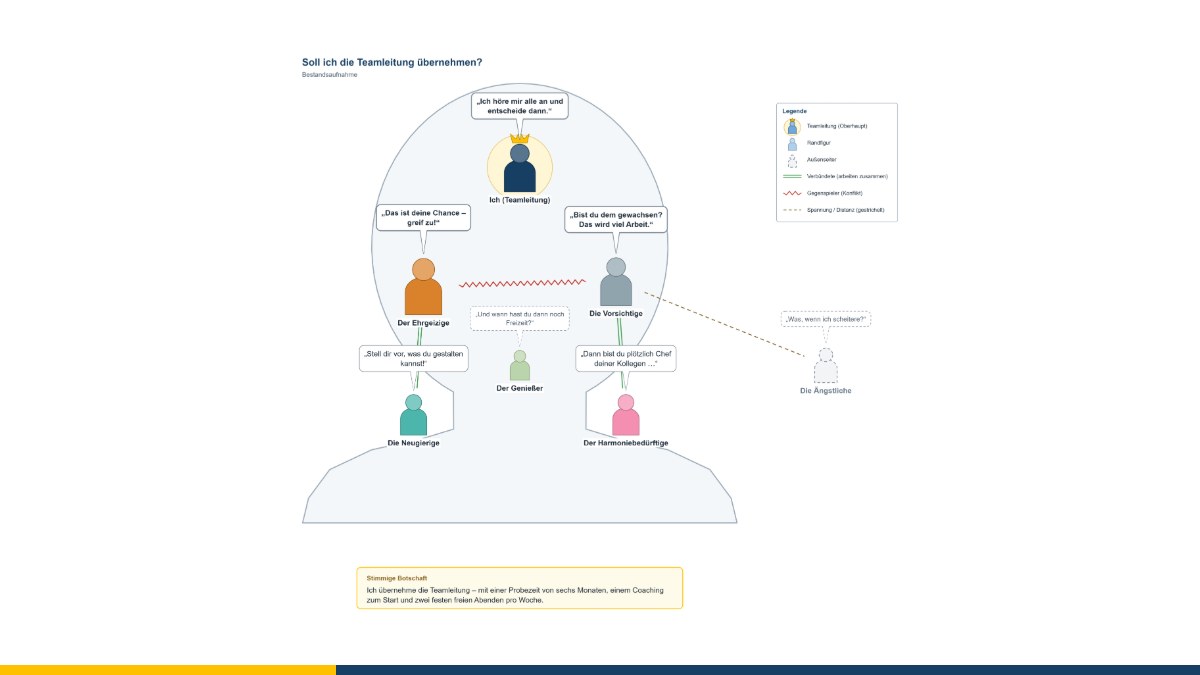
“On the one hand I'd like to say yes, on the other …” – Anyone facing a decision often hears several inner voices at the same time. The inner team model gives these voices names and a place. This makes it possible to clarify who is speaking up, what good each voice is aiming for and how a coherent stance can emerge from them. I introduced the model itself in my post on the inner team; here the focus is on the practical work – including with the editor.
At a glance
- The inner team describes the different, often contradictory inner voices of a person.
- The model was developed by the Hamburg communication psychologist Friedemann Schulz von Thun.
- The aim is an inner team conference that leads to a coherent message you can readily stand behind.
- The free inner team editor shows the voices as figures with speech bubbles.
Aim of the method
Inner contradictions are normal – and valuable. Each voice represents a legitimate concern: the cautious voice wants to avoid harm, the ambitious one wants to get ahead, the caring one looks after your health. It becomes difficult when one voice dominates everything, others go unheard or the voices block each other.
Working with the inner team helps you to recognise the voices, acknowledge their concerns and, as the “team leader”, arrive at a decision you can stand behind wholeheartedly. In coaching it is particularly suitable for decisions, difficult conversations, new leadership roles and situations in which you feel “not quite yourself”.
Where the method comes from
Friedemann Schulz von Thun described the model in detail in the third volume of his series “Miteinander reden” (Talking with each other, 1998). In doing so, he drew on older ideas of inner parts, such as those developed in Roberto Assagioli's psychosynthesis (“subpersonalities”) or by the family therapist Virginia Satir (“Parts Party”), and translated them into the language of communication psychology: the inner voices form a team with a leader who – like a good manager – facilitates, listens and integrates. Today the model is one of the best-known tools in coaching, consulting and leadership development in the German-speaking world.
How to work with the inner team
- Clarify the issue: What question or situation is it about?
- Gather the voices: Who is speaking up? Each voice gets a concise name and its core message as a short sentence.
- Arrange them: Who is loud, who is quiet? Who stands at the front, who on the sidelines? Who is not heard at all? Who works together, who against each other?
- Acknowledge the concerns: What good is each voice aiming for?
- Team conference: The team leader lets each voice have its say, opponents listen to one another, quiet voices are invited to speak.
- Integration: Formulate a coherent message that takes the most important concerns into account – and the next step.
Working with the inner team editor
- Figures and speech bubbles: Each voice appears as a figure with a name and a message. Its role – team leader, team member, peripheral member or outsider – determines where it stands.
- Influence: Five levels from “very quiet” to “very loud” change the size of the figure.
- Suggestions: 16 typical voices, such as the driver, the critic, the cautious one or the curious child, as inspiration – freely editable.
- Relationships: allies, opponents, tension and influence shown as lines.
- Phases: Taking stock, team conference and solution as separate pictures in one file. The coherent message can appear below the picture.
- Report and export: A printable report summarises the issue, all phases, the voices and the outcome. You can also export as PDF, PowerPoint, LibreOffice Impress, Visio, SVG and PNG.
The editor runs entirely in your browser and does not transmit any data. It is free of charge and available as free software under the GPL: Open the inner team editor in your browser.
In coaching, the inner team serves as a model for reflection and dialogue, not as a diagnostic instrument. Coaching does not replace psychotherapy.
Conclusion
People who know their inner voices make clearer decisions and come across more convincingly. If you would like to arrange your own inner team – for example before an important decision or in a new leadership role – get in touch for a free initial consultation.
Sources: Schulz von Thun, F. (1998): Miteinander reden 3. Das „Innere Team“ und situationsgerechte Kommunikation. Reinbek: Rowohlt. – Assagioli, R. (1965): Psychosynthesis. New York: Hobbs, Dorman.
Thinking further
You can find more on this topic under resources and downloads – or talk to me directly in a free initial consultation.
Comments
Comments are published immediately with your name. Only the name, title, comment text and time are stored – see the privacy policy.
Loading comments …