
This article was created with the AI assistant Claude and published by Peter Hoenig.
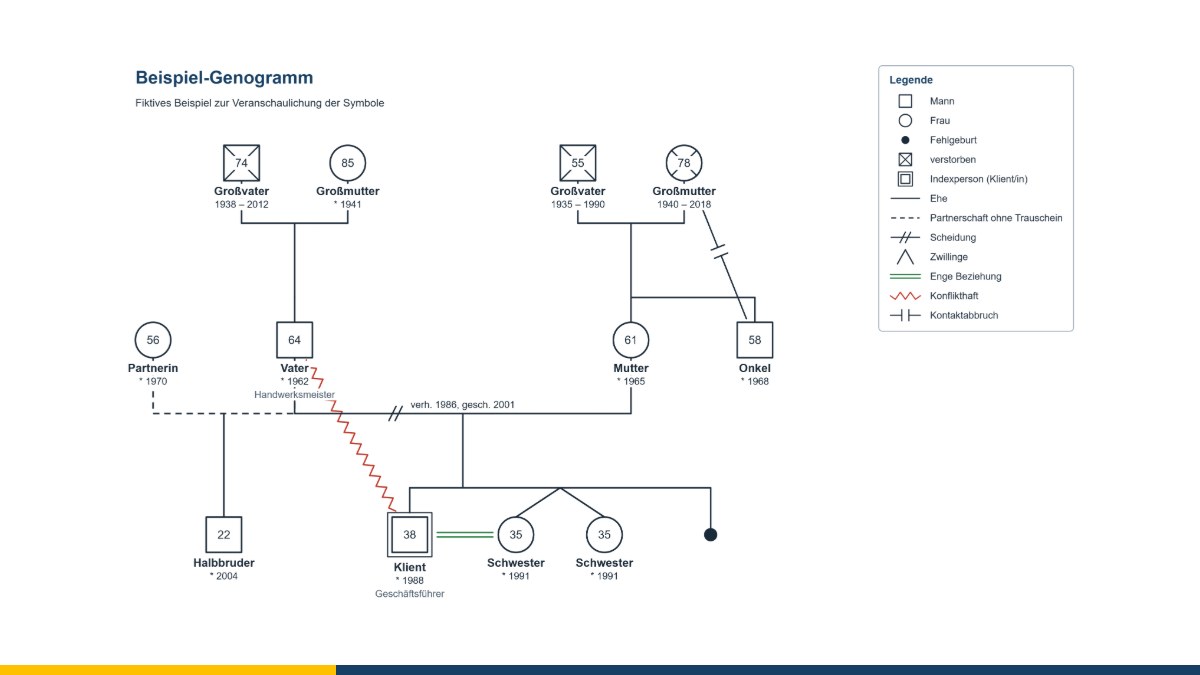
A genogram is more than a family tree: it shows not only who is related to whom, but also how relationships are experienced and which themes repeat themselves across generations. In coaching, it helps you understand your own origins as a formative influence and as a source of strength – for example in questions of career choice, your own leadership role or succession in a family business.
At a glance
- A genogram usually depicts three generations using standardised symbols.
- The method comes from systemic family therapy and was standardised in the 1980s.
- In coaching it is used to reflect on roles, patterns and resources – not for diagnosis.
- With the free genogram editor, you can create a genogram directly in your browser.
The aim of the method
A genogram makes visible what often remains scattered in conversation: family structures, separations, early losses, occupations, migrations, illnesses, special events – and the nature of the relationships. This gives rise to questions that open up new perspectives: Which expectations have shaped me? What role did I have in my family, and where do I find it again in my team today? Who in the family mastered crises, and what can I learn from that?
Looking at resources is important. A genogram shows not only burdens but also people, abilities and values that someone can draw on.
Where the method comes from
The idea of looking at families across several generations goes back largely to the American psychiatrist Murray Bowen and his family systems theory. He assumed that patterns in dealing with closeness, conflict and responsibility are passed on within families.
The symbols commonly used today were compiled by Monica McGoldrick and Randy Gerson in 1985 in their book "Genograms in Family Assessment". Since then, the genogram has been a standard tool in family therapy, social work and medicine – and increasingly in coaching and consulting as well, for example with family businesses.
How to create a genogram
- Start with yourself, then add your partner, children, parents, siblings and grandparents.
- Use the usual symbols: a square for men, a circle for women, a horizontal line for partnerships, and the children below it in order of age from left to right.
- Add important details: years of birth, occupations, places of residence, special events.
- Draw in the quality of the relationships – close, distant, conflictual or broken off.
- Look at the picture together: What strikes you? Which themes recur? Who was important to you? Which strengths come from your family?
The conversation about the picture matters more than a complete picture. What is told – and what is left out – is often revealing.
Working with the genogram editor
I developed the genogram editor so that genograms can be created quickly, neatly and without specialist software:
- People: man, woman, gender unknown, as well as pregnancy, miscarriage and termination of pregnancy. For each person you can enter a name, dates and details.
- Quick add: partner, sons, daughters, parents and siblings with a single click – the lines are drawn automatically. Twins can be shown as well.
- Relationships: close, very close, distant, conflictual and close-conflictual relationships, cut-off and violence.
- Frames and text boxes: for example to mark a household or to add notes.
- Saving and export: The genogram is saved as a file on your computer. Exports are available as PDF, PowerPoint, LibreOffice Impress, Visio, SVG and PNG – in PowerPoint and Impress the shapes remain editable.
The editor runs entirely in your browser and does not transmit any data. It is free of charge and available as free software under the GPL.
A genogram touches on personal and sometimes painful topics. In coaching, it serves as a model for reflection and dialogue, not as a diagnostic instrument. Coaching is not a substitute for psychotherapy.
Conclusion
A genogram brings order to a family's history and opens your eyes to patterns and resources. Try out the genogram editor – or talk to me in a free initial consultation if you would like to use the method in coaching.
Sources: McGoldrick, M.; Gerson, R. (1985): Genograms in Family Assessment. New York: Norton. – Bowen, M. (1978): Family Therapy in Clinical Practice. New York: Jason Aronson.
Thinking further
You can find more on this topic under resources and downloads – or talk to me directly in a free initial consultation.
Comments
Comments are published immediately with your name. Only the name, title, comment text and time are stored – see the privacy policy.
Loading comments …