
This article was created with the AI assistant Claude and published by Peter Hoenig.
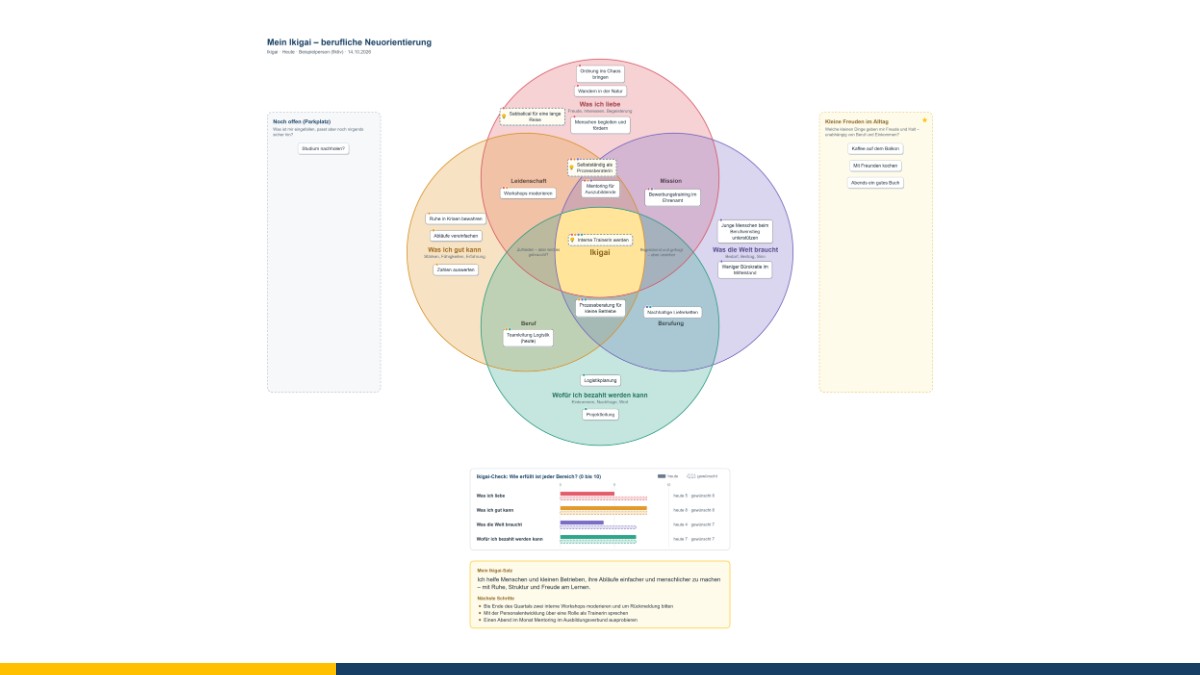
What makes me glad to get up in the morning? Many people ask themselves this question when they make a fresh start in their career, come to the end of a family phase or are approaching retirement. The Japanese word “Ikigai” roughly means “that which makes life worth living”. In coaching, a diagram of four circles is widely used for this. It helps you put your own answers in order – and find ideas for bringing more of it into your everyday life.
At a glance
- The four-circle diagram asks: what I love, what I am good at, what the world needs and what I can be paid for.
- Where two circles overlap lie passion, mission, vocation and profession – with Ikigai in the centre.
- In Japan, Ikigai often also refers to the small joys of everyday life, not just the great meaning of life.
- The free Ikigai editor sorts your answers into the circles, assesses ideas and records your Ikigai statement and next steps.
The aim of the method
The Ikigai diagram invites you to answer four questions separately and then to see where the answers come together. The gaps are particularly interesting: what I love and am good at, without anyone paying for it, is a passion – perhaps a hobby, perhaps a future offering. What I am good at and get paid for, without loving it, is a profession – solid, but perhaps not fulfilling. Which overlaps are well filled, which are empty? And which idea would strengthen several circles at once?
Incidentally, the centre is often empty. That is not a shortcoming but a good starting point for the conversation. In coaching, I use the diagram above all for career reorientation and for the question of how to shape a stage of life in a meaningful way. For teams and companies, it is a good way into vision and mission: What do we love, what are we good at, what do our customers need, what do people pay us for?
Where the method comes from
In 1966, the Japanese psychiatrist Mieko Kamiya explored Ikigai in a much-noted book. The neuroscientist Ken Mogi emphasises that Ikigai also lies in small things – in the morning coffee, in a chat with the neighbours, in a job well done. The four-circle diagram, by contrast, is a Western representation: it goes back to a diagram by the Spaniard Andrés Zuzunaga and was linked with the term Ikigai in 2014 by the entrepreneur and blogger Marc Winn. Since then, it has become widespread in coaching. This is worth knowing – the diagram is a helpful model for dialogue, but not a Japanese teaching.
How to work with the Ikigai diagram
- Collect: note down answers for each of the four circles – without evaluating them. Guiding questions help.
- Connect: place answers that fit several circles in the corresponding overlap.
- Take a look: Which areas are filled, which are empty? What stands out?
- Assess ideas: rate possible steps or options by how strongly they meet each circle.
- Evaluate: How fulfilled is each circle today, and how should it be?
- Record: formulate a personal Ikigai statement and agree on small next steps.
Working with the Ikigai editor
- Four circles and their overlaps: enter cards on the left or place them directly in the picture. Where a card belongs depends on its position; while you drag it, a label shows the area.
- Small joys and parking lot: one box for the small joys of everyday life and one for thoughts that do not have a place yet.
- Ideas and options: rate ideas for each circle with 0 to 5 points; if you wish, the editor places them in the matching area.
- Ikigai check: “today” and “desired” for each circle from 0 to 10 – with a note on the largest gap.
- Several pictures: for example “Today” and “In three years”; the record shows what is new, what has shifted and what has dropped out.
- Templates: personal Ikigai, and organisation or team. Labels, guiding questions and colours can be changed freely.
- Saving and export: save as a file, printable record, export as PDF, PowerPoint, LibreOffice Impress, Visio, SVG, PNG and as a table for Excel.
The editor runs entirely in your browser and does not transmit any data. It is free of charge and available as free software under the GPL: Open the Ikigai editor in your browser.
In coaching, the Ikigai diagram serves as a model for reflection and dialogue, not as a diagnostic instrument. Coaching does not replace psychotherapy.
Conclusion
The Ikigai diagram does not make your life decisions for you – but it helps you ask the right questions and sort out your own answers. If you are facing a career reorientation, I will be glad to support you through Personal Coaching. Get in touch for a free initial consultation.
Sources: Kamiya, M. (1966): Ikigai ni tsuite (On Ikigai). Tokyo: Misuzu Shobō. – Mogi, K. (2017): The Little Book of Ikigai. London: Quercus. – Winn, M. (2014): What's your Ikigai? Blog post, The View Inside Me.
Thinking further
You can find more on this topic under resources and downloads – or talk to me directly in a free initial consultation.
Comments
Comments are published immediately with your name. Only the name, title, comment text and time are stored – see the privacy policy.
Loading comments …