
This article was created with the AI assistant Claude and published by Peter Hoenig.
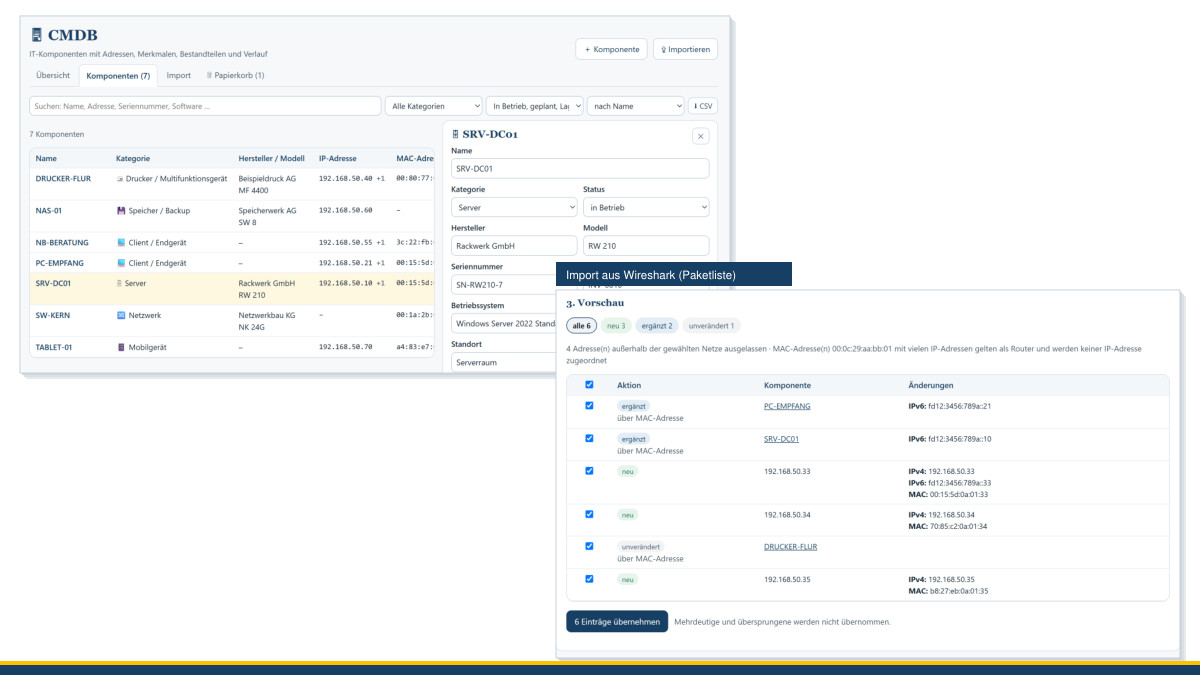
When a printer goes on strike, a laptop can no longer get onto the network or a server is due to be replaced, the work almost always begins with the same questions: Which device is it exactly? Where is it, who is it assigned to, what address does it have, what runs on it? In small and medium-sized enterprises, the answers are often scattered – in an Excel list, in Active Directory, in the DHCP server and in the head of the person who “does the IT”. That is why I have given the MC4Y Productivity Suite its own CMDB, a configuration management database for the IT components. Incidents, problems and changes from the ITSM tool can be linked to these entries, and the 8EM Modeller transfers its IT systems, platforms and components to the CMDB.
What makes up a component
Every component has a name, a category and a status: in operation, planned, in stock, defective or retired – and, for applications and platforms, also the phases of the lifecycle as in the 8EM Modeller: idea, project, introduction, operation (“in operation”), decommissioning planned and decommissioned. Decommissioned and retired entries only appear in the list if you ask for them. In addition, every component carries a classification – physical, software or abstract –, which the CMDB pre-sets from the category (a server as physical, say, “Application / IT system” as abstract) and which can be changed freely; devices reported by an agent or the crawler are automatically set to “physical” (software to “software”). On top of this come the usual basic details such as manufacturer, model and serial number, the location and who is responsible for the device. Anything else that matters – processor, memory, warranty until, supplier, maintenance contract – you enter as an attribute; the CMDB suggests the common ones, and you can add your own at any time.
For software, services and applications there are dedicated fields: the version – you keep each major version as its own component – and the deployment (local, on a server, in the internal or an external cloud); licence and maintenance costs are cost entries like all costs (see below). This keeps track of which software runs where, in which version and at what cost; the list can also be filtered by deployment.
You choose the location and the people responsible from the Suite’s master data or enter them freely; next to the field it says which applies. If a name changes there, the CMDB shows the new one, and no import overwrites the reference. If an entry is still missing from the master data, buttons such as “+ Create person in the master data” or “+ Create location in the master data” create it straight from the form. Free texts from earlier lists that match an entry in the master data – in person responsible and location as well as in the cost type and cost centre of cost entries – are linked in one step on the page “🔗 Link free texts to the master data”; a notice in the overview shows the way there.
Components rarely stand alone: an application runs on a server, a server is attached to storage. You create such relationships in the form; they appear on both components, and nothing you have created by hand is replaced by a tool of the Suite. The CMDB export contains them, and when an export is imported they are kept – as are groups, costs and the references to the master data.
Categories that fit your organisation
The seventeen categories supplied are a suggestion, not a specification. On the “Categories” tab you create your own – “Machine / plant” in a manufacturing business, “Medical device” in a practice –, rename existing ones, give them a different symbol, sort them and hide what you do not need. Hidden categories are no longer offered for selection; components that already carry them keep them. When creating a component you can simply type a category – if it does not exist yet, the CMDB asks whether to create it.
When a category is renamed, all existing components and the crawler’s networks are carried along; internally the CMDB works with a fixed identifier, not with the name. That is why the agents, the comparison with the 8EM Modeller and the automatic grouping keep working after a rename. The CMDB also remembers the previous name: whoever still saves with it – from a form opened earlier, a list or the 8EM Modeller – lands in the renamed category instead of creating a second one with the old name. Deleting is only possible when the category is empty – otherwise only after you have expressly said where its components should be moved to. Three categories can be renamed and hidden but not deleted: “Software / service”, “Group / suite” and “Other” – the CMDB creates entries there itself, and the interface says so on the spot. Creating your own category requires write access to the CMDB; everything else requires full access.
Software, installations and groups
The CMDB keeps installed software not as a part of a device but as its own component per product and major version – “Microsoft Word 2021” and “Microsoft Word 2024” are two entries. For each piece of software you can see which devices it is installed on: “installed on n devices”, plus how many of them still report in. If a device stops reporting for a longer time, a weekly run removes its installation entry again (the period – 30 days by default – is configurable; the software component itself is kept for now, see “Clean up”). That way the number shows where a piece of software really still runs, without being distorted by machines that signed off long ago. Devices maintained by hand never age out. On Linux computers, only explicitly installed packages become components of their own; the many dependencies the system brings along are listed together as the part “System packages” on the device.
Related components can be combined into a group or suite – the programs of an office suite, for instance. The group is itself a component with its own form; on it you keep what applies to the whole suite, such as the licence. You can assign from both sides by hand – choose a group on the software, or add members on the group. For software found automatically there is a maintainable rule list “product → group” (pre-set, e.g. Word, Excel, PowerPoint and Outlook → “Microsoft Office”): newly reported software is then placed in the matching suite on its own. An assignment made by hand always takes precedence and is never overwritten by the automation.
A component can have several addresses: IPv4, IPv6, MAC address and DNS name. Each address belongs to exactly one device. If an IP address is given to a different device – after a replacement, for instance – it moves across with it, and the CMDB records the change. Under Parts you will find services, shares, drives with their partitions, connected devices and network cards; installed software, by contrast, is kept by the CMDB as its own components (see above).
Every device also carries its origin: created by hand, recorded in the ITSM tool (with the ticket number), imported from Excel, a CSV or text list, Active Directory, a DHCP list or Wireshark, transferred from the 8EM Modeller, reported by an agent on the device, found by the crawler during a network scan or taken over from a CMDB export – for imports, including the file name. In addition, the device shows the date it was created, the date it was last changed and, if a list has confirmed it, when it was last seen. This lets you spot, for example, entries that came from an old list once and have never turned up again since.
You can search the list – including addresses, attributes and software – filter it by category, status, origin and classification, and sort it by name, category, manufacturer, location, last change, creation date or “last seen”. For an overview, the CMDB start page shows the number of devices per category, per origin and per classification, the most recently changed entries and the latest imports.
What does a component cost, and who bears the costs?
Every component keeps its costs as cost entries, as many as it needs: amount, cost type and cost centre (from the master data or entered freely), one-off, monthly or annual, as plan, forecast or actual. This way purchase, maintenance and licence sit side by side, each on the cost centre that bears it. The “Costs” tab evaluates everything by cost centre × cost type, converts to annual values and shows one-off amounts separately, also as a CSV file; components in the recycle bin do not count.
On updating, the CMDB makes a backup and converts the former cost text fields into entries itself; anything it cannot read as an amount stays as a note. Cost columns in imported lists become entries too.
Importing existing lists
Hardly any company starts from scratch. That is why the CMDB reads in what already exists – by dragging the file into the window or by pasting a copied table. It recognises the format by itself and assigns the columns; anything it does not know, you assign with a few clicks or take over as an attribute.
- Excel or CSV: any list with a header row, such as your existing inventory. Columns such as name, IP address, MAC address, manufacturer, model, serial number or location are recognised; the CMDB provides a template for you to fill in.
- Active Directory: the computer accounts with operating system and last logon, for example with
Get-ADComputer -Filter * -Properties DNSHostName,OperatingSystem,OperatingSystemVersion,IPv4Address,Description,LastLogonDate | Export-Csv rechner.csv -NoTypeInformation -Encoding UTF8. Disabled accounts can be left out when importing. - DHCP: the leased addresses with MAC address and device name, on the DHCP server for example with
Get-DhcpServerv4Scope | Get-DhcpServerv4Lease | Export-Csv dhcp.csv -NoTypeInformation -Encoding UTF8. - Wireshark: lists from a capture of your own – the endpoints, the packet list as CSV or the resolved addresses. If the packet list also contains the MAC addresses, the CMDB matches IP and MAC addresses to each other. A MAC address behind which there are many IP addresses is recognised as a router and not assigned to any device.
- CMDB export: from another MC4Y Suite, for example when moving to a server.
So that addresses from the internet do not show up as devices of your own, the CMDB by default only takes addresses from the private network ranges; you can also enter your company's networks yourself, for IPv4 as well as IPv6.
There is one limit that matters to me: the import does not scan any network itself – it only reads files that you give it. From Wireshark the CMDB takes only addresses and names, never the contents of the capture. Network captures can, however, contain personal data – so only capture in your own network and in line with your company's internal rules. If you would rather record the inventory continuously and automatically than from files, you set up the agents or the crawler from the next section deliberately.
Recording automatically: agents and crawler
Importing lists is one way; the easiest way, though, is for the inventory to maintain itself. For that there are two small helpers that the IT staff set up in their own network: an agent that runs on a device and reports its inventory, and a crawler that scans the networks you enter for reachable devices. Both are inventory only, send only to your own suite and keep the data in your network – and they exist for Windows, Linux, Raspberry Pi, macOS, Android and Home Assistant.
How this is set up, what the agents report and what to bear in mind about virus scanners and firewalls is covered in detail in its own post, Agents and crawler: IT into the CMDB automatically.
Matching with a preview
When importing, the CMDB looks for the matching device for each row – first by serial number, then by MAC address, then by name (without the domain) and finally by IP address. Placeholders that some manufacturers enter instead of a real serial number do not count. If a row matches several devices, the CMDB would rather not take it over than assign it wrongly, and shows it as “ambiguous”.
Before anything is saved, you see every row in the preview: new, supplemented, unchanged or ambiguous – for supplemented rows with the details before and after. You can deselect individual rows. The preview actually runs the import and then rolls it back; what it shows is therefore exactly what happens when you apply it.
Nothing you have entered or corrected by hand is overwritten by a later import. This means you can re-import the list from Active Directory every week without losing your own details; the CMDB only adds what is new and records when it last saw a device.
How does the CMDB stay free of duplicates and leftovers?
If the same device reaches the CMDB by two routes – from a list and from the agent, say –, you merge the duplicate in the form: a preview shows what will be taken over; the remaining component receives addresses, parts, installations, relationships and costs without duplicate entries, and the duplicate goes to the recycle bin. The former identifier can still be found – including for tickets in the ITSM tool, the solution database and the 8EM Modeller.
When deleting, a dialogue first shows the consequences and suggests also deleting software that would then be installed on no device and automatic groups that would become empty; an agent that reports the device can be deregistered in the same step. Everything belongs to one deletion run and comes back together. A device in the recycle bin is not recreated by an agent or the crawler. Whatever builds up nonetheless is removed by “Clean up” – only what was created automatically and nobody has maintained by hand; the weekly run does this on its own.
Permissions, backup and data protection
As with all parts of the Suite, the permission groups determine who may read and edit the CMDB and import lists: read, read and write, or full access – only with full access can anything be deleted permanently, merged or cleaned up.
The CMDB has its own database in the Suite's data folder: if the Suite runs on your computer, the database is stored there; if it runs on a server, it is on the server. The Suite's daily backup includes it and checks it too; it is also backed up separately before every update. Export as CSV or JSON is possible at any time.
Device data, too, can relate to people – for example when a laptop is assigned to a person, bears their name or Active Directory shows the last logon. Whoever runs the Suite is responsible for this data; the Suite's privacy information describes what the CMDB stores. It transmits nothing to the outside world.
Frequently asked questions
Which status can a component have in the CMDB?
In operation, planned, in stock, defective or retired. Applications and platforms also go through the lifecycle phases of the 8EM Modeller: idea, project, introduction, operation (“in operation”), decommissioning planned and decommissioned. Whatever the Modeller transfers when you save brings its phase along as the status; decommissioned and retired entries only appear in the list if you ask for them.
How do devices get into the CMDB without retyping?
From lists out of Excel or CSV, from Active Directory, from the DHCP server and from Wireshark – each time with a preview of what would be created and what only supplemented. If you wish, small agents and a crawler report the inventory by themselves, and IT systems from the 8EM Modeller arrive when the model is saved.
Where is the CMDB data kept?
In a database of its own in the Suite's data folder – on your computer or your server, without any cloud. The Suite's daily backup includes it.
What comes next
The CMDB is the foundation. The first connection is already in place: in the ITSM tool, any number of components from the CMDB can be assigned to every Incident, Service Request, Problem and Change – live in the Suite; if a device is missing, you record it in the ticket and, if you wish, create it in the CMDB straight away. Dedicated reports show which device keeps causing trouble, which changes led to follow-up incidents and where known errors apply. You can read more about this in the post on the ITSM tool. The second connection is the 8EM Modeller, which I use to map companies in the 8-Level Model: when you save a model in the Suite, it transfers IT systems, technical architecture plans, platforms and IT components to the CMDB – with a status taken from the lifecycle and attributes such as standardisation, place of operation and ICT object. Whatever is already maintained in the CMDB stays as it is; the Modeller does not recreate anything that has been moved to the recycle bin. Conversely, entries from the CMDB can be assigned in the model, for example in the grid of an architecture plan. In this way, the device list becomes part of the overall picture: Which processes depend on which server, and what does replacing it mean for the people who work with it?
The CMDB is part of the MC4Y Productivity Suite, which you can download as a trial version from Experimental – software and tools to try out and install yourself. I have tested it with invented lists; I would be glad to receive feedback from real networks.
Would you like to bring order to your IT landscape or align it with your processes? Get in touch – you can find more on this under IT-supported organisational consulting.
Trademark notice: Microsoft, Active Directory and Excel are trademarks of Microsoft Corporation; Wireshark is a registered trademark of the Wireshark Foundation. The names are used for descriptive purposes only; there is no connection with the trademark owners.
Thinking further
You can find more on this topic under resources and downloads – or talk to me directly in a free initial consultation.
Comments
Comments are published immediately with your name. Only the name, title, comment text and time are stored – see the privacy policy.
Loading comments …