
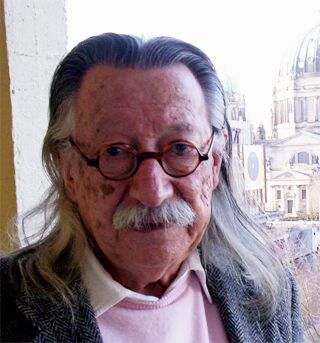
Source: https://commons.wikimedia.org/wiki/File:Joseph_Weizenbaum.jpg Joseph Weizenbaum (professor emeritus of computer science at MIT). Taken on the balcony of his flat in Berlin, Germany. Date 11 February 2005 Source Own work Author Ulrich Hansen, Germany (Journalist). This file is licensed under the Creative Commons Attribution-Share Alike 3.0 Unported license.
Joseph Weizenbaum (1923–2008) was a German-American computer scientist, MIT professor, one of the earliest and sharpest critics of an unreflective euphoria about computers and AI, and one of the defining computer scientists of the 20th century – but above all someone who had the courage, early on, to question the hype surrounding computers and AI critically.
Born in Berlin, Weizenbaum emigrated to the USA with his Jewish family in 1936 to escape persecution by the National Socialists. This biographical experience shaped his lifelong distrust of technical power without moral control.
After studying mathematics, he first worked in industry before becoming professor of computer science at MIT. He gained international recognition in 1966 with the program ELIZA, which simulated simple therapeutic conversations. The users' reactions – many attributed genuine understanding to the program – shook him to the core. Instead of feeling proud, he was deeply shaken and alarmed.
This experience prompted him to write his main work, "Computer Power and Human Reason" (1976; in German: "Die Macht der Computer und die Ohnmacht der Vernunft"). In it he formulated a core thesis that still holds true today:
"Not everything that is technically possible should actually be done."
Weizenbaum drew a strict distinction between calculating and understanding, between a tool and a moral authority. Computers, he argued, may support us, but must never replace human responsibility, judgement or conscience – especially not in sensitive areas such as medicine, law, war or education.
Until his death, Weizenbaum remained an uncomfortable voice of warning: technologically highly competent, morally clear and sceptical of blind faith in progress.
He saw early on the danger that people attribute more to machines than they are capable of. After ELIZA, he was downright shocked at how quickly people became emotionally dependent.
He warned against handing decision-making power over to computers – above all in medicine, war, the justice system and public administration.
Today he is regarded as a pioneer of AI ethics and as a voice of reason in an increasingly automated world. With the rise of AI programs such as ChatGPT, Copilot, Claude, ... this applies all the more today. AI can support us, but responsibility must not be transferred to an AI, and the results of AI must always be critically checked and questioned.
A classic, down-to-earth stance: what humans have to answer for, they must not hand over to machines – or, to put it another way:
Joseph Weizenbaum reminded us that humans must remain in charge – and that technology without ethics has no future.
For him, one thing was clear: technology is a tool. People, their values, their experience – that is the yardstick.
Thinking further
You can find more on this topic under the 8-Level Model – or talk to me directly in a free initial consultation.
Comments
Comments are published immediately with your name. Only the name, title, comment text and time are stored – see the privacy policy.
Loading comments …