
This article was created with the AI assistant Claude and published by Peter Hoenig.
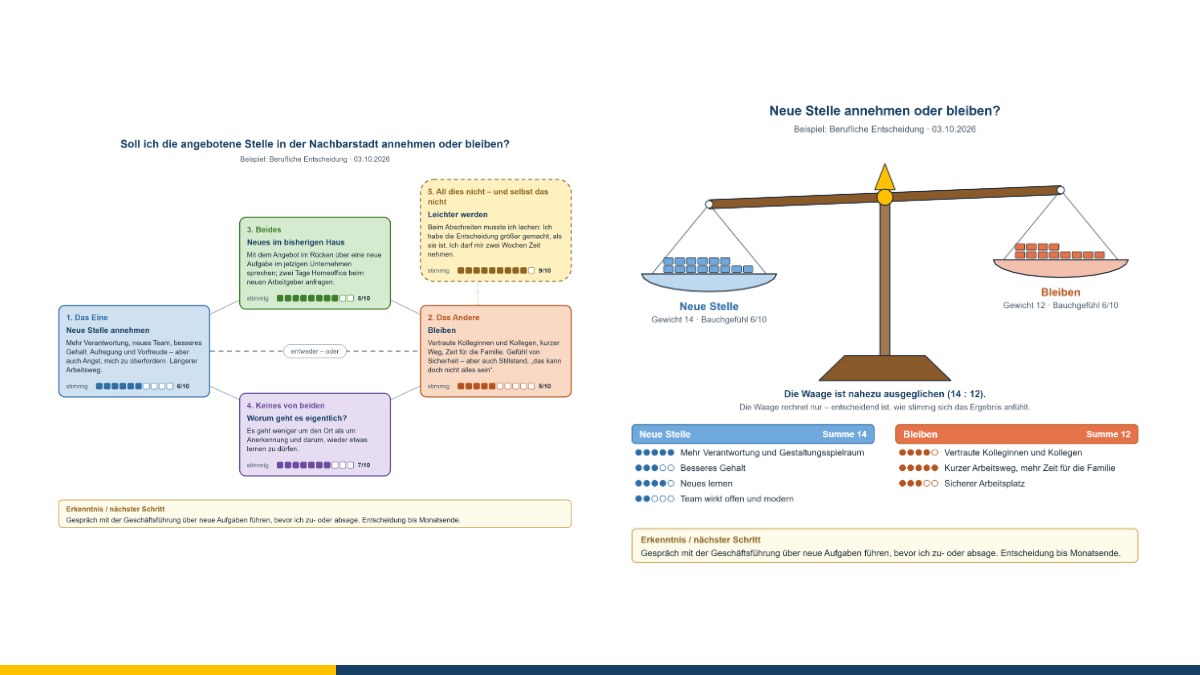
“Should I take the new job or stay?” – “Do we invest now or wait?” At first, many decisions look like an either-or. Two methods help you see such questions more clearly: the tetralemma opens up the view beyond the two obvious options. The decision balance weighs up the reasons and shows how much each one weighs. In the decision editor, you can combine the two in a single file.
At a glance
- The tetralemma looks at five positions: the one, the other, both, neither – and “none of this, and not even that”.
- The decision balance weighs reasons for and against one option, or between two options.
- The two methods complement each other: first open up the range of possibilities, then weigh them up.
- The free decision editor supports both in your browser.
The aim of the methods
The tetralemma releases mental blocks. If you are stuck between two options, it is often only the positions “both” and “neither” that reveal what the issue is really about – or a third solution that was not in view before.
The decision balance brings order to the reasons. It shows which arguments really carry weight and makes contradictions between head and gut visible. It does not decide for you – but it makes clear what matters to you.
Where the methods come from
The tetralemma comes from Indian logic: the “fourfold negation” (Catuṣkoṭi) examines a statement in four forms – it holds, it does not hold, both, neither. The Buddhist philosopher Nagarjuna (around the 2nd century) used this form of thinking and went one step further. In the 1990s, Matthias Varga von Kibéd and Insa Sparrer developed the tetralemma further for consulting and systemic structural constellations and added the fifth position.
The decision balance has a long history. As early as 1772, Benjamin Franklin described his “moral algebra” in a letter to Joseph Priestley: write the reasons for and against in two columns, weigh them and cross out reasons of equal weight against each other. In 1977, the psychologists Irving Janis and Leon Mann developed this into the “decisional balance”. Motivational interviewing, as developed by William R. Miller and Stephen Rollnick, uses a balance with four fields: the advantages and disadvantages of changing and of keeping things as they are.
How the methods are applied
Tetralemma:
- Name the two obvious options: the one and the other.
- Take each position seriously: What do I gain? Which values are fulfilled? What would I have to give up?
- Both: How could the two be combined – one after the other, in part, in a new way?
- Neither: What is it really about? What has been overlooked so far?
- None of this – and not even that: let go of everything and look at the question with fresh eyes, and with a sense of humour, too.
- Assess each position: How right does it feel?
Decision balance:
- Choose the form: two options, for and against, or the four-field balance for change.
- Collect all the reasons without evaluating them straight away.
- Weight each reason.
- Look at the balance – and at your gut feeling: Does the result feel right? If not, what is still missing?
Working with the decision editor
- Switch: tetralemma and decision balance in one file – you can first explore a concern and then weigh it up.
- Tetralemma: five positions with guiding questions, notes and a rating from 0 to 10. The diagram shows the four positions as a diamond and the fifth outside it.
- Decision balance: three variants; each reason has a weight from 1 (not very important) to 5 (very important). The balance tips towards the heavier side.
- Gut feeling: a slider records how it feels. If the calculation and the feeling contradict each other, the editor points this out – often an important prompt for the conversation.
- Saving and export: save as a file; export as PDF, PowerPoint, LibreOffice Impress, Visio, SVG, PNG and as a table for Excel.
The editor runs entirely in your browser and does not transmit any data. It is free of charge and available as free software under the GPL: Open the decision editor in your browser.
In coaching, the tetralemma and the decision balance serve as models for reflection and dialogue, not as diagnostic instruments. Coaching does not replace psychotherapy.
Conclusion
Good decisions need both: new possibilities and honest weighing-up. If you are facing an important career or business decision, I will be glad to support you through Business Coaching. Get in touch for a free initial consultation.
Sources: Varga von Kibéd, M.; Sparrer, I. (2000): Ganz im Gegenteil. Tetralemmaarbeit und andere Grundformen Systemischer Strukturaufstellungen. Heidelberg: Carl-Auer. – Janis, I. L.; Mann, L. (1977): Decision Making. New York: Free Press. – Miller, W. R.; Rollnick, S. (2013): Motivational Interviewing. 3rd ed. New York: Guilford. – Franklin, B.: Letter to Joseph Priestley of 19 September 1772.
Thinking further
You can find more on this topic under resources and downloads – or talk to me directly in a free initial consultation.
Comments
Comments are published immediately with your name. Only the name, title, comment text and time are stored – see the privacy policy.
Loading comments …