
This article was created with the AI assistant Claude and published by Peter Hoenig.
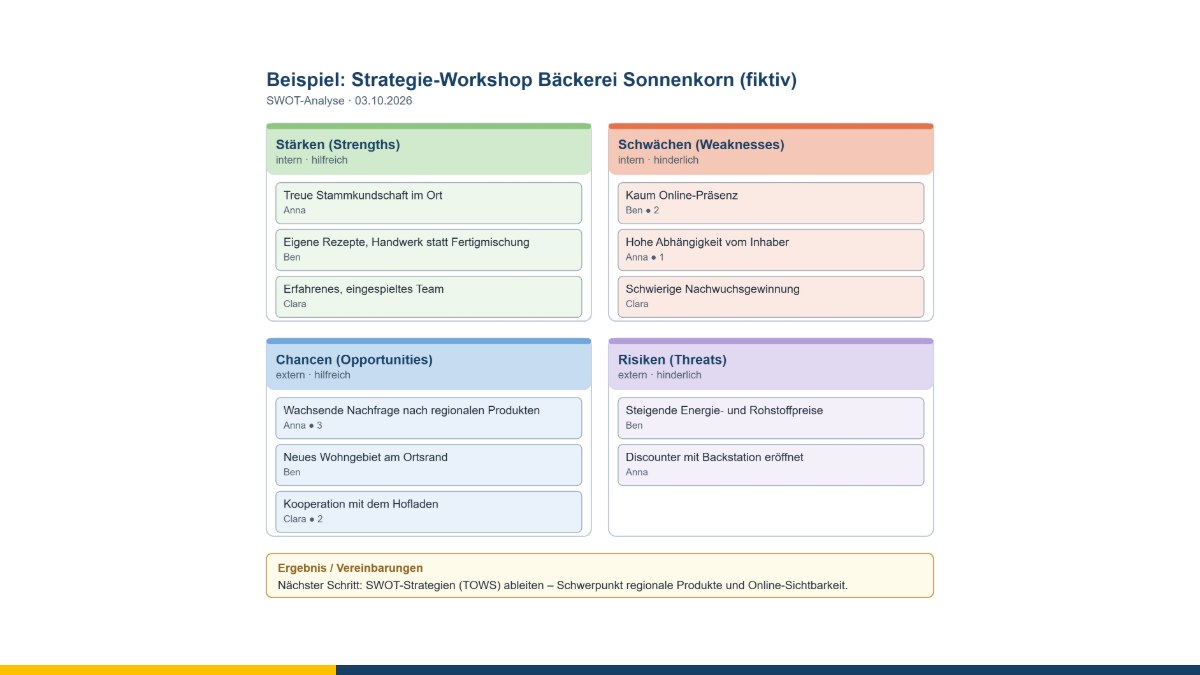
Whether it is a strategy retreat, a team meeting or a coaching conversation: a good structure helps to put thoughts in order and to involve everyone taking part. For many occasions there are tried-and-tested methods with a few clear fields. In this post I present the most important ones – and the analysis editor, with which you can use them on your own or as a team.
At a glance
- SWOT and TOWS analyse strengths, weaknesses, opportunities and threats and derive strategies from them.
- SOAR is the appreciative, future-oriented alternative to SWOT.
- GROW structures coaching conversations in four phases.
- Start–Stop–Continue, PMI and the retrospective are suitable for feedback and learning together.
- The Johari window and the values and development square help with self-image, the image others have of you and personal development.
- The Eisenhower matrix and the energy balance sort tasks and energies – for time and self-management.
- The free analysis editor offers all the templates, dot voting, a time box and, optionally, real-time team sessions.
The methods: aim and origin
SWOT analysis: It looks internally at strengths (S) and weaknesses (W) and externally at opportunities (O) and threats (T). It emerged in the 1960s in the circles of Harvard Business School and the Stanford Research Institute; exactly who originated it is disputed. Today it is one of the best-known tools of strategy development.
SWOT strategies (TOWS): In 1982, Heinz Weihrich described how strategies can be derived from a SWOT analysis by combining internal and external factors: using strengths to seize opportunities (SO), reducing weaknesses in order to take advantage of opportunities (WO), using strengths to ward off threats (ST) and limiting weaknesses and threats (WT).
SOAR analysis: In 2003, Jacqueline Stavros, David Cooperrider and D. Lynn Kelley presented SOAR – strengths, opportunities, aspirations and results. The method comes from the tradition of Appreciative Inquiry and focuses on what works and what is possible.
GROW model: John Whitmore made it widely known in 1992 with his book “Coaching for Performance”. A conversation passes through four phases: Goal, Reality, Options and Will (or way forward). GROW is one of the most widely used coaching models in the world.
Start–Stop–Continue: a quick feedback format: What should we start doing, what should we stop, what should we continue? It is widely used and has no specific originator.
PMI (Plus, Minus, Interesting): Edward de Bono developed this thinking method in order to look at an idea deliberately from all sides before judging it.
Retrospective: In 2001, Norman Kerth described project retrospectives as learning together from experience; in 2006, Esther Derby and Diana Larsen applied them to agile teams. The basic questions are: What went well? What didn't? What do we learn from it? What do we resolve to do?
Johari window: In 1955, Joseph Luft and Harrington Ingham described four areas of self-perception and perception by others: the open area (known to me and to others), the blind spot (known to others, but not to me), the hidden area (known to me, but not to others) and the unknown. Feedback shrinks the blind spot, openness the hidden area. The name is made up of the first names of the two authors.
Values and development square: Every value needs a “sister value” that keeps it in balance – thrift, for example, needs generosity. If the balance is missing, the value tips over into too much: thrift turns into stinginess. The idea goes back to the characterologist Paul Helwig; Friedemann Schulz von Thun extended it into the development square in 1989. The direction of development runs diagonally – from your own exaggeration towards the sister value.
Eisenhower matrix: It sorts tasks by importance and urgency into four fields: do it now, schedule it, delegate it, drop it. The distinction between important and urgent is attributed to the former US President Dwight D. Eisenhower; as a four-field matrix it became known through Stephen R. Covey, among others.
Energy balance: Energy givers and energy drainers are set against each other – at work and in private life – and from this follows what there should be more of and what less of. The format is common in coaching; there is no single originator.
How the methods are applied
- Choose the right method: SWOT or SOAR to take stock, TOWS for strategies, GROW for a goal-focused conversation, Start–Stop–Continue, PMI or a retrospective for feedback and learning, the Johari window or the values square for personal development, the Eisenhower matrix or the energy balance for priorities and energies.
- Formulate the question clearly – for example “How do we position our service for the next three years?”.
- Collect contributions, initially without discussing them. In groups, silent writing on cards has proved its worth.
- Sort, summarise and weight them with dots.
- Record specific next steps: Who does what by when?
Working with the analysis editor
- Templates: SWOT, SWOT strategies (TOWS), SOAR, GROW (in phases), Start–Stop–Continue, PMI, retrospective, Johari window, values and development square, Eisenhower matrix, energy balance and a custom template. Each field has guiding questions; fields, notes and guiding questions can be adapted.
- Cards: type, press Enter – done. Cards can be edited directly and dragged into other fields.
- Facilitation: dots for rating with an adjustable budget per person, focus on one field or phase, a time box with countdown, anonymous cards and a presentation view for the projector.
- Real-time team session (optional): All participants work on the same board at the same time via an invitation link and a PIN. The session runs via my web server, is deleted after seven days at the latest and can be ended at any time by the person leading it. Taking part requires consent; details can be found in the privacy policy.
- Saving and export: save as a file, export as PDF, PowerPoint, LibreOffice Impress, Visio, SVG, PNG and as a table for Excel.
Without a team session, the editor runs entirely in your browser and does not transmit any data. It is free of charge and available as free software under the GPL: Open the analysis editor in your browser.
The templates serve as structures for reflection and dialogue, not as diagnostic instruments. Coaching is not a substitute for psychotherapy.
Conclusion
The right structure makes meetings shorter and results clearer. If you are planning a strategy retreat, a retrospective or a workshop, I will gladly support you with facilitation and team development. Talk to me in a free initial consultation.
Sources: Weihrich, H. (1982): The TOWS Matrix – A Tool for Situational Analysis. Long Range Planning 15 (2). – Stavros, J.; Cooperrider, D.; Kelley, D. L. (2003): Strategic Inquiry with Appreciative Intent: Inspiration to SOAR. AI Practitioner. – Stavros, J.; Hinrichs, G. (2009): The Thin Book of SOAR. Bend: Thin Book Publishing. – Whitmore, J. (1992): Coaching for Performance. London: Nicholas Brealey. – de Bono, E. (1982): de Bono's Thinking Course. London: BBC Books. – Kerth, N. (2001): Project Retrospectives. New York: Dorset House. – Derby, E.; Larsen, D. (2006): Agile Retrospectives. Raleigh: Pragmatic Bookshelf. – Luft, J.; Ingham, H. (1955): The Johari Window, a Graphic Model of Interpersonal Awareness. Proceedings of the Western Training Laboratory in Group Development. Los Angeles: University of California. – Helwig, P. (1967): Charakterologie. Stuttgart: Klett. – Schulz von Thun, F. (1989): Miteinander reden 2. Stile, Werte und Persönlichkeitsentwicklung. Reinbek: Rowohlt. – Covey, S. R. (1989): The 7 Habits of Highly Effective People. New York: Simon & Schuster.
Thinking further
You can find more on this topic under resources and downloads – or talk to me directly in a free initial consultation.
Comments
Comments are published immediately with your name. Only the name, title, comment text and time are stored – see the privacy policy.
Loading comments …